


Candidate for Winnebago Sheriff brings non-traditional ideas into November campaign
Dani Falesnik, a licensed mental health professional, seeks to introduce trauma-informed care into law enforcement, which they say would make for better outcomes for officers and the public

It’s hard to imagine a more daunting challenge than the one that Dani Falesnik set for themselves in late April.
That’s when Falesnik, with the advice and backing from a group of friends and supporters, and after much consideration, decided to enter the Winnebago County Sheriff’s race to replace long-time incumbent John Matz.
While it’s always a step into the void for any first-time political candidate, the one Falesnik was taking was particularly fraught. Not only would they be entering an arena dominated by alpha men, they would be doing so identified as a non-binary person, and one lacking in law enforcement experience at that. Further, they would be offering a proactive platform focused on root causes and trauma that radically veers from the traditional more reactive law-and-order approach that defines most county sheriff departments.
They’re taking it on, they say, because they see the traditional one-dimensional hardline approach to law enforcement as ineffective. As a licensed mental health professional, they not only understand the complexity of human nature and human interaction, they’ve done research into the efficacy of what is known as the trauma-informed approach, one that focuses on root causes and offers proactive front-end solutions as opposed to reactive measures that often lead to tragic outcomes.
They say the traditional approach has created a climate of mistrust among the citizens of Winnebago County, something that must be taken into account if the county is to have effective, cooperative law enforcement. They don’t blame the officers themselves, they insist, but rather the system they are forced to work under.
Bridging the gap of understanding
In what will eventually become a 17-part series of two-minute clips on their social media page that takes the viewer through what trauma-informed policing entails, Falesnik, who is running as an Independent, attempts to bridge the gap of understanding. That will be essential if they are to break through against their two opponents, whose platforms adhere to traditional messaging.
While Falesnik’s approach risks sounding soft on crime, perhaps more concerned with empathy for those who pose risks to public safety than with public safety itself, they say they are actually just seeking better outcomes for all, including the officers themselves.
“Police misconduct starts with moral injury,” Falesnik explains in one of those early videos. “When officers are forced into situations where their actions conflict with their values or they feel unsupported by a rigid hierarchical system, their mental health suffers and misconduct rates can climb. The research shows that trauma-informed psychological skills can reduce police misconduct by improving decision-making skills while under stress.”
Falesnik says the law enforcement officer, the person suffering from a mental health crisis and public safety are all better served if the officer understands going into a situation what to look for. Falesnik says research as well as our understanding of human nature, suggests that officer is much less likely to overreact to a person in crisis if they recognize the trauma underneath the behavior, be it shame or even fear over the officer’s presence. Public safety would still come first, they say, but de-escalation would be the first tool to reach for.
A new way to look at law enforcement
The concept of trauma-informed care started to gain traction a little more than a decade ago. The state of Wisconsin put money behind it and Falesnik became one of its trainers at the time. Trauma-informed care was meant to be applied in any human interaction within government organizations and public schools.
Addressing root causes within systems is always an uphill battle in the United States. For one, it requires upending traditional policies that, if even through inertia itself, people are loath to change. It also means a radical rearranging of priorities and practices, something potentially as cumbersome as trying to turn a tanker around in a narrow canal. The temptation is to just keep moving forward even if the results remain unsatisfactory and the underlying problems ignored.
This sclerotic tendency seems particularly entrenched in law enforcement, Falesnik says.
“The position is an elected position for a reason, and it's to prevent people just kind of being promoted from within in that kind of good old boys mentality, and then nothing in the system really changes,” Falesnik says.
They assert that, with the way the patriarchy is structured, especially in the law enforcement arena, there is reticence to speak out or speak up.
“You could have a room of ten people in it, and one loud one says something completely heinous and off the wall, and the other nine, because they don’t want to be conflictual or disrupt their social favor, keep their mouths shut,” they say. “So what I'm seeing with law enforcement that has spoken directly with me is they're very supportive (of my approach), but the risk is always if (I) don't win, then what? Then (that officer) is outed as this soft natured person. So there's always this kind of world of combat and competition and machismo that is just inherently toxic.”
Needing resilience
Though Falesnik may be promoting a novel approach to law enforcement in the state, they are undeniably serious-minded and intelligent, not just cerebrally but emotionally as well. Their engagement with the world is informed not only by their training and education in behavioral health (which includes a master’s degree) but by their work within the mental health system.
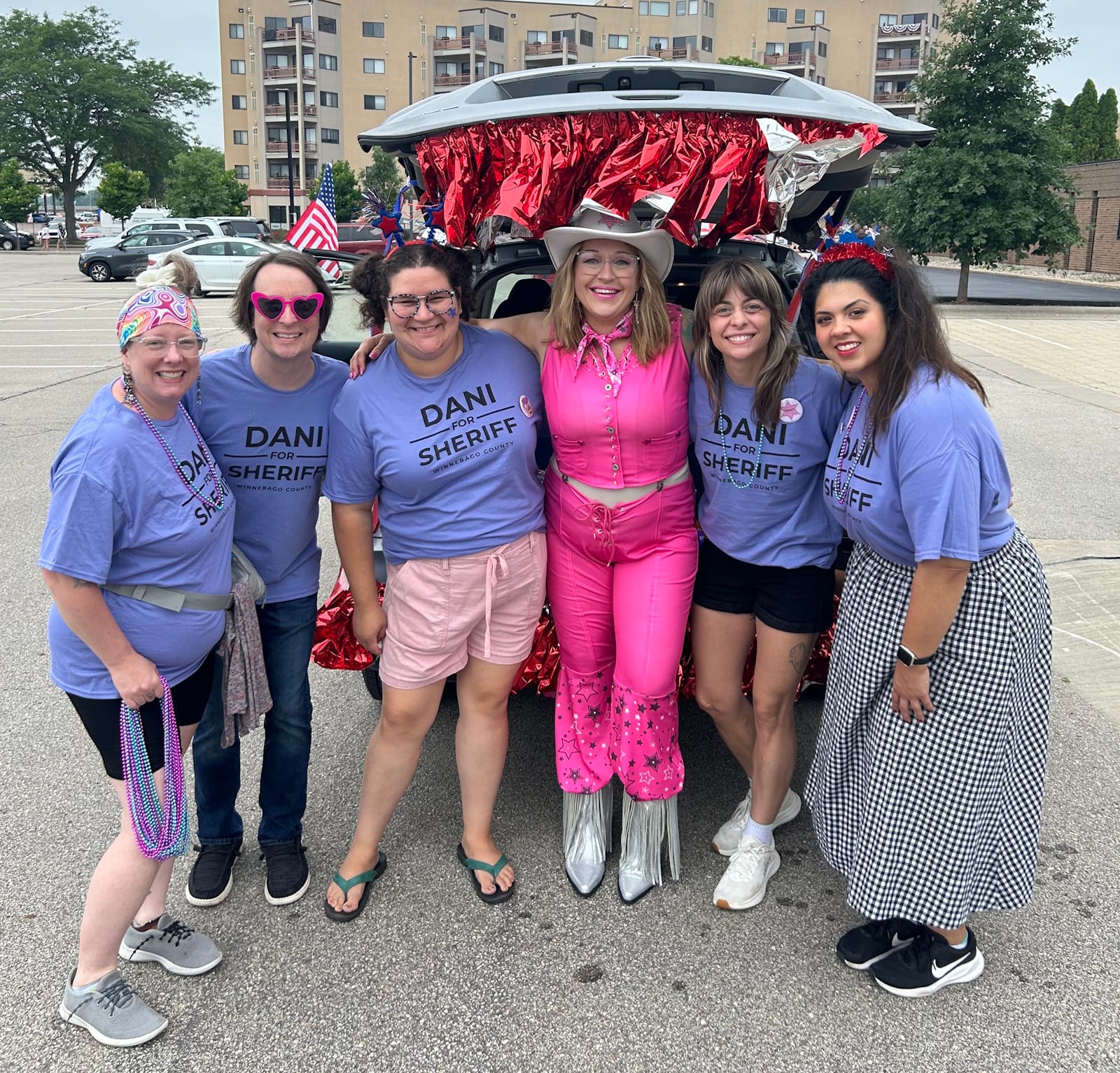
Sara Erickson, a volunteer with the Dani for Sheriff campaign, says Falesnik is the type of person who can enter a loud and chaotic room and pretty quickly get everyone on the same page.
“She (while non-binary, Falesnik does not worry about pronoun usage) does so in a way that is filled with understanding backed by her years of training and education and experience,” Erickson says. “She’s good at understanding people and she understands not everything people say to her or about her is a direct reflection of her but perhaps of the struggles they themselves are going through. She knows how to work through that and that has definitely allowed her to be resilient.”
Resilience has been critical through the first three months of the type of campaign that is fertile ground for male toxicity. They had to ask the Winnebago County Republicans to stop posting content that they saw as an incitement to violence. They and their supporters also had to stop campaigning door to door.
“There was an incident where a man was making threats to break my nose and when I found he had past restraining orders, I filed a report,” Falesnik said. “And the Winnebago County Republicans online were just turning it into identity politics but I was able to turn it around and just say, ‘I’m flattered but don’t your guys have a candidate you can talk about?’
“And I think the issue is that they are just so stuck in the traditional way it’s always been so they see me as a bigger threat to them than they see the other candidates as assets.”
An 'unwell' society
In that respect, trauma-informed care has actually informed Falesnik’s own resilience throughout the campaign, which includes equanimity and an ability to recognize the pain and fear behind some of those ugly responses. They say such shame-based attacks on them have been built into our society. The campaign, they admit, has opened their eyes to just how “unwell” our society has become.
“The system is designed to keep people compliant by just activating their fear systems over and over again,” they say. “You know, I think I had some pretty thick rose-colored glasses on still when I went into it, and I think it took a little bit of calibrating, but I got my sea legs fast because I've had a lot of experience going into crisis-level situations, ER rooms at three or four o'clock in the morning, and not really ever knowing what I'm walking into.
“This was very reminiscent of those crisis triage kinds of experiences where it's like, ‘all right, what's going on? What fire needs to get put out first?’ And also learning what is okay to just walk away from.”
While Falesnik is not doing this as a stunt and is in it to win it, they realize it’s a long shot at best. That seems to be of less importance to them than simply amplifying some new ideas and educating people on new ways of looking at systems. They say they’re happy in their career and love their job running their own outpatient clinic.
“The reason I decided to take on this campaign was because I'm seeing massive cracks in the foundation of the system and that the men who are running are phoning it in,” they say. “And even though maybe the Democratic option is a little less scary, the reality is that I don't think anything will improve under the aforementioned good old boys system.”
ICE out
Falesnik’s work has included 10 years with the Shawano County Health Services and, briefly, as the behavior health manager in Menominee County. They say their work within the very systems that link up so critically with the Sheriff’s Department make them uniquely qualified to lead the county.
“Am I really an outsider?” they ask in one of their 'Why a therapist is running for Sheriff' videos. “Is someone who has worked in county human services and rehab systems really an outsider? I’ve been in the same trenches with a different set of tools.”
Falesnik says their lack of law enforcement background is no longer a liability now that a Sheriff has become first and foremost an administrator. They say leading a department armed with a keen understanding of how trauma and behavior are interconnected would not only result in better results public-safety-wise it would make for a much more effective force. Officer burnout and secondary trauma, Falesnik argues, is a problem seldom addressed.
Beyond trauma-informed care, Falesnik’s big issues are maximizing grant funding, banning controversial Automated License Plate Readers and removing Winnebago County from its 287-g agreement with the Immigration and Customs Services (ICE). Faselnik does not consider ICE to be law enforcement, especially after unidentified agents wearing masks began making mass arrests under legally dubious and sometimes illegal pretenses, provoking terror among citizens and killing, according to an ACLU estimate, anywhere from six to 11 unarmed people.
“ICE is a group of the president's private militia, honestly, that is out causing and spreading terror,” Falesnik says. “They are murdering people because they are untrained, they are underprepared, they are underfunded. It's just dudes in camo and sneakers and masks and to me, it's a gross violation of our constitution.
And I think if I am looking at what my role as the sheriff is, what I return to in a moral or ethical dilemma is always going to be: What does the Constitution say, and are we upholding that, or are we trying to dismantle it? And so, if there is for some good reason that you know we're contacted by DHS, and they're like, "Hey, we need to send so and so up here. There's a guy who just bought two tons of fertilizer and a bunch of electrical equipment, and we're pretty sure he's building bombs and he's here from wherever. I'll help with things like that, but the blanket targeting of citizens based on race or political agenda is not something I'm willing to put my name behind.”
It doesn't have to be like it's always been
Falesnik says there was apprehension when the topic of running came up back in March or April. It was, can we do this? Should we do this? Yeah, we should do this. They have paid a price emotionally. Even with a healthy ego, emotional intelligence and an understanding of human nature, the attacks have taken a toll. They admit to occasional paranoia and even agoraphobia. They have had to suppress who they are by watching how they say certain things in certain environments.
But to watch their video installments is to witness someone who is quietly strong and confident in their ideas, who knows their stuff and who knows how to deliver a message in a way that may not break through to everyone but just might provoke thought in people who were previously unreachable.
And there has been joy, such as when they and their team collected their 500th nomination signature.
“It was such a great feeling,” they say. “LIke, I can’t believe we did that. That’s insane. But it also speaks to my tenacity, if nothing else.”
For Sara Erickson, it has been inspiring to watch her friend take it all on.
“I would say the undertaking itself was just born of this idea that we need to get out there and we need to show people that it doesn't have to be the same as it's always been,” she says. “That new people can come out, new ideas can be presented, and that people can be responsive to that. They can interact with it, and even if they may not fully adopt those ideas, just the fact that they're presented with them and that they listen to them, I think is progress.
“We deserve to have people in leadership who are willing to listen to us, who are willing to look at the research that we have and understand how to better serve our communities. And people have been responsive to that, and that's been absolutely wonderful.”
Candidate for Winnebago Sheriff brings non-traditional ideas into November campaign © 2026 by Kelly Fenton is licensed under CC BY-NC-ND 4.0


