


Win or lose, Tseffos thinks difficult conversations with voters is the only way back
She's leading with heart-felt messages about the issues plaguing the state and the country, combined with pleas for finding common ground on what she thinks are human values we all share.

The days are as long and isolated as the rural roads she travels. The driveways that lead to the doors of the strangers with whom she is trying to make connections often seem to go on forever.
And there is no guarantee those folks will open their doors to her, even if they are home. The ones who do – in a rural part of a bright red district – will more than likely be carrying a natural wariness, if not outright antipathy, toward the message she brings.
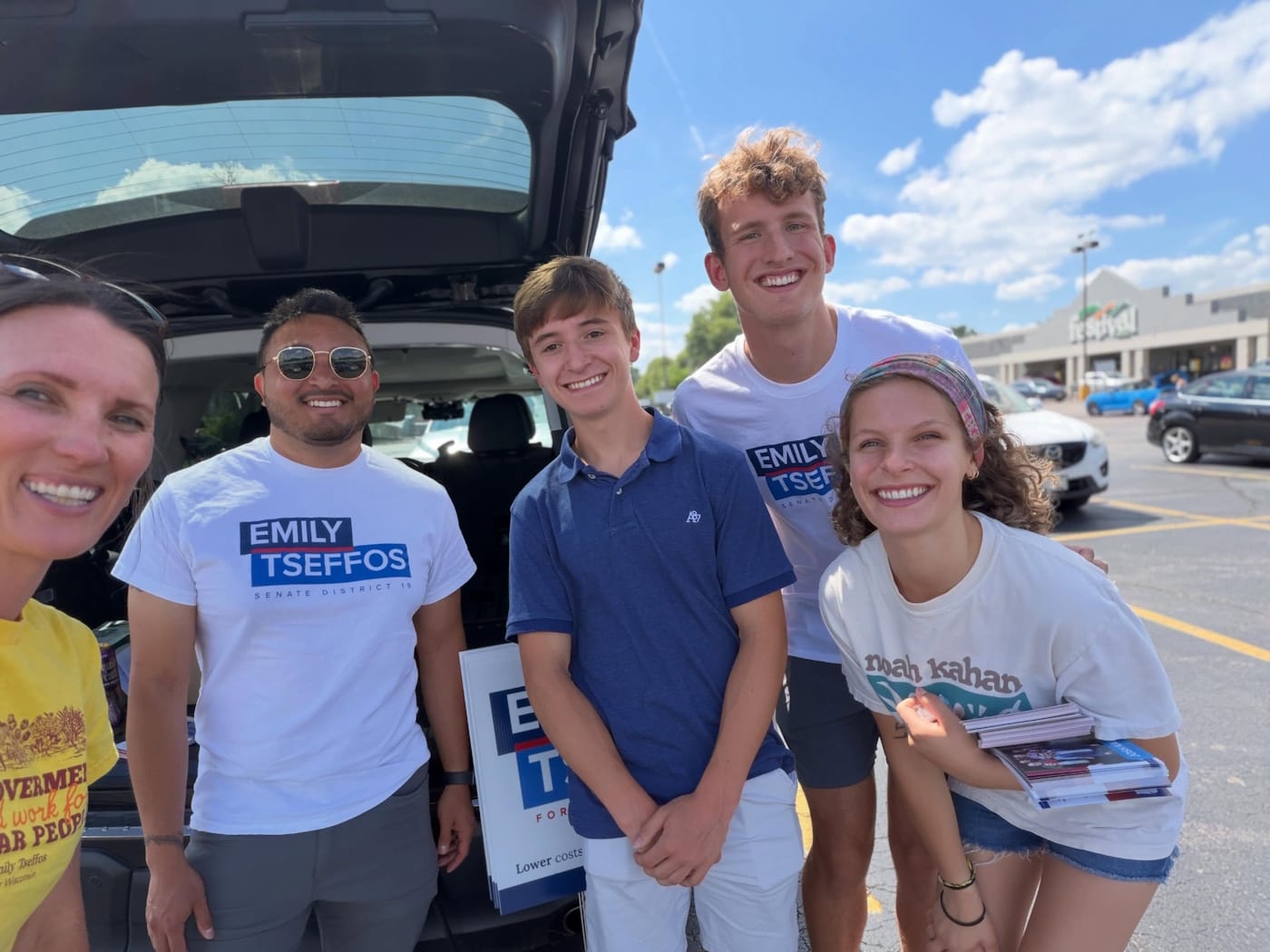
Emily Tseffos does this sometimes a hundred times in a day, often as many as five days a week. And she’s been doing it since June. She does it knowing that beating Republican incumbent Rachel Cabral-Guevara in State Senate District 19 is a long shot, indeed. Though Cabral-Guevara won her first term by just 9 points in 2022, President Trump carried it by nearly 26 points two years ago after a redrawing of the maps that year tilted the Republican lean significantly.
She’s doing it, she says, hoping she doesn’t sound like a cliche, for her kids, all of whom have been directly impacted by policy decisions in both Washington and Madison. For her son Niko, who has Neurofibromatosis, a rare tumor-causing disorder, President Trump’s significant cuts to federal medical research mean a reduction in the chances for NF breakthroughs, and cuts to Medicaid could ultimately impact his treatment and care.
For adopted son Raj, who has an Individual Education Plan in the Freedom School District, cuts to the Department of Education have a real potential to threaten his development. Raj was also born in India, and xenophobia and bigotry are on the rise.
For daughter Aurora, a setback in women’s rights and a surge in toxic masculinity makes the world she is growing up in both more ominous and restrictive.
“I mean, I just need them to know that I did what I could,” says Tseffos, an activist for the past decade and currently, the Chair of the Outagamie Democrats. “You know, like if (things go really bad) and they start sending kids like Raj to institutions because they no longer have public schools, I need him to know that I did what I could. If they pull back Medicaid and he and Nico need treatment and he can't get treatment or he can't get coverage or he has to travel, I need him to know Mom tried, so there's that.
“This is all super personal to me.”
Seeking connections
Emily Tseffos’ campaign for State Senate, like the one she ran for State Assembly in 2024, is broad-minded and open-hearted. Her earnest efforts to make connections with those on the other side of the political spectrum – and that includes voters who still support President Trump – have earned her a following on social media, where she regularly posts urgent, heart-felt messages about the issues plaguing the state and the country, combined with pleas for finding common ground on what she thinks are human values we all share. Those things include economic justice, respect and care for the environment, affordability, a social safety net for the folks who desperately need it, whether that be hard-working people struggling to survive or those unable to work, medical care that doesn’t bankrupt families, and taking care of the elderly.
You can witness the occasional breakthrough, when a conservative poster applauds Tseffos for her commitment to listening, to engaging in earnest dialogue, to striving for common ground. These often take the form of, I don’t agree with much of what you say but I appreciate your willingness to listen to the other side and be respectful. We need more of that.
She has won some over along the way. In 2024 she planted the occasional Tseffos for State Assembly sign right next to a Trump 2024 sign in someone’s yard.
It helps that she puts her values into action, organizing efforts for relief following the floods in Shawano earlier this year, and after the tornado in Menasha in July and August.
Breaking out of our silos
Though a staunch progressive who isn’t willing to compromise her values, Tseffos doesn’t lead as a Democrat at doors. She introduces herself instead as a mom and a teacher.
“I understand more intimately how intertwined a person's identity is right now with their politics,” she explains. “I'm never going to go to the door and switch a Republican to a Democrat. Even being able to extend some trust to a Democrat is a really tough ask for people, because it means that you're admitting that within your own self there was something wrong with what I believed or what I thought (about Democrats).”
Tseffos, herself, admits to engaging in that sort of tribalism before she ran in 2024. It was one of the great lessons she took from that race, she says.
“I definitely had put myself in a progressive bubble and I kind of wrote off people outside of town, where I was like, ‘Oh my God, why are you so red? Why are you voting against your own interests?’” she says. “But when I talked to them, I realized, oh, you're working really hard, and you don't think anyone's coming to save you because no one has, and you're 75 years old. And so, of course, you're gonna feel disaffected.
“And so I think I wrote off a lot of people before this. (That’s why) I don't like the purity testing that I see happening with Democrats because I'm like, you guys, these are good-hearted people, and if we don't start talking to each other, it's only going to get worse. And you calling someone stupid or saying you're voting against your own health, your wealth, your well-being, it's not helpful.”
Overcoming mass manipulation
The battle Tseffos is waging in trying to win a State Senate seat is not strictly against Cabral-Guevara or Republicans. The battle, as she sees it, is being fought on many fronts: social media, isolation, self-interest, algorithms, mass manipulation, distraction, toxic masculinity, tribalism. It’s a lot to overcome but she thinks of all the problems plaguing our politics and our society at large, these are the main culprits.
“There's mass manipulation happening in spaces that are well funded on purpose,” she argues. “People are being distracted by non issues. We've allowed misinformation, tropes, and lies to take root, and no one's countered them. That's why I think door-knocking and just being present and being vocal is so important.
“So we're so focused on ‘bathroom issues,’ or ‘What is a woman?’ or choose whatever the flavor of the day is, that we don't talk about those (important issues) anymore, and that's purposeful. Like, we're arguing while they're pulling all the strings over here.”
Rising prices, affordability, trying to survive economically – that’s where she thinks the great common denominator is. We’re all feeling it, she insists. No one can manipulate a person into believing that his dwindling disposable income or inability to pay the bills are fake news. One voter she spoke to was upset that the compromise deal between Gov. Tony Evers and the GOP earlier this year was voted down. He wanted the $300 rebate that was part of the package, though legislators on both sides thought the overall package was bad for the state.
“(He) worked for a heating and cooling company and he told me, ‘I don’t have any wiggle room (financially),’” Tseffos recalled. “And I was like, here's the thing, would 300 bucks fill up your tank one time? And I asked him, but what if we could work on doing things that would keep utilities capped or at least lower? Or that rise in healthcare costs? I'm more interested in keeping your monthly bills down.
“If you get a little bit of a break on your property taxes, but your health care keeps rising, and your child care keeps rising, and your utilities go up, is that really a break, or did they just bill you in a different way? It's a gimmick. I don't want to see you stressing at the end of every month.”
Public education a priority
Yet through manipulation via ads and memes on social media voters are being told that funding the government or raising taxes on corporations or the wealthy is socialism.
Tseffos laughs at those messages though she finds it far from funny. It goes to the heart of what plagues us, she says, to those people “pulling all the strings” with the intent of distracting us from the very real problems facing working families.
“I’m a capitalist,” she says. “My husband owns a small business. But government is supposed to do the greatest good for the greatest number of people.”
To that end, she says her first priority in Madison is for the state to get back to fully funding public education. Because of state-imposed revenue limits starting in 1993 along with the end to inflationary adjustments beginning in 2009, public education has been forced to make up the resulting gaps through referendums that ultimately fall to taxpayers in the district. Those same taxpayers are paying for vouchers as well, often for families that would have chosen to send their kids to the private school with or without those taxpayer subsidies.
Furthermore, special education reimbursement comes in at only about 35 percent for public schools and 90 percent for private schools, who can deny them enrollment.
Tseffos knows first-hand this last detail. Xavier, where she sends Nico and Aurora, denied Raj because private schools, unlike public schools, are not obligated to accept kids with special needs. She tells voters she’s not opposed to vouchers but to the system the way it is currently constructed. She points out that the state is obliged only to fund public education, not two separate systems.
“My problem is not with private schools existing; it's that they're taking public money, and the only system that's mandated to accept every single kid is our public schools,” she says. “Until they're playing by the same rules, they shouldn't be getting those public tax dollars.”
The state has piled up a nearly $3 billion surplus while choosing not to fund things such as public education. One of the ways Tseffos suggests the state can get back to restoring that funding is through adjustments to the tax code.
“We're worried about subsidies at the bottom for the mom that can't afford to put groceries on her table, but not worried about giant corporations that are getting millions in cuts, and that's what I want to go after,” she says.
Drawn into activism
Tseffos came upon activism through the side door. She taught for the Peace Corps in both Mexico and Nicaragua, but it wasn’t until Trump was elected in 2016, while her husband was in residency in Nashville, that she was pulled into it, first by participating in the Women’s March on Inauguration Day.
Over the next couple of years, Tseffos became involved in two sexual assault cases, first with the Enough is Enough movement after Stanford swimmer Brock Turner was sentenced to just six months after being convicted of rape; then, with the attempt to remove Tennessee state legislator David Byrd after he was found to have sexually assaulted three high school girls he coached in the 1980s. While Byrd was eventually removed from his committee chair – an education committee, no less – he won re-election following the scandal by a larger margin and never paid any consequences for his crimes.
Tseffos said her experience with both the Turner and Byrd cases made her realize that a lot of the people in power just don’t care about the harm they’ve done to women.
Tseffos is a survivor of sexual violence herself, something she doesn’t hesitate to bring up when talking to a pro-life voter. She’s not there to change their beliefs, merely to itemize for them the real-world consequences of denying women access to abortion. Her willingness to be vulnerable with voters but also exposing to them her lived reality has broken down some barriers on a topic that generates more heat than light.
Leading with her heart as she does, she is a target for the kind of toxic masculinity that seems to have metastasized over the past decade. On social media, she’ll attempt to engage until it becomes obvious that it’s futile and harmful.
“ I think it's just indicative of the pervasiveness of violence against women, and that we think nothing of it,” she says. “And what is most disheartening, I walked up to a door and it was a young couple, and they're like, ‘We're raising daughters,’ and I was like, ‘Okay, cool, we're gonna find solidarity here.’
“But no, it was transgender issues, and I was like, ‘Can we talk about the Epstein files? Can we talk about domestic violence?’ When I walk to my car at night with my keys between my hands, I'm not worried about a transgender person jumping at me. It's a straight white man. That’s what's sad to me because we have to undo generations of that type of thinking.”
‘I have resources, I have privilege, and I have responsibility …’
Tseffos admits to feeling frustrated at times when she realizes she has been doing so much work while her opponent is cruising, occasionally showing up to meetings but likely not engaging in much, if any, voter outreach. That ‘R’ on the ballot carries more weight for some voters than actually talking about how issues and policies are impacting their lives.
She has reached out several times to Cabral-Guevara to try to set up a debate or a forum, but has yet to get a response. The same thing happened in her 2024 State Assembly race, when incumbent Dave Murphy didn’t respond to Tseffos’ invitation to discuss the issues in front of the voters.
Whatever happens, Tseffos believes her efforts are necessary if we are to break the logjam in our politics, if we are ever to reconnect with each other following this last dark decade. People are isolated and frightened and just want to feel safe, she says, but that doesn’t guarantee safety – certainly not for those most impacted by harmful policy.
“People go in their houses,” she says. “They assume they’re alone. They assume that their problems are only theirs. If they can keep their four walls in place, they don't need to worry about anybody else. And that's a privilege that I'm trying to open people's eyes to.
“And there are others who are working too hard, and they're just like, I’ve got to hold this together because that's all I can do. But I think for me, knowing that I have time, I have resources, I have privilege, and I have responsibility to my kids, I want to connect the dots for people that don't have a voice, that don't have the time or the resources. And to say, hey, those problems you just told me about are connected to policy and they are screwing you. Let's go fix them. Let's get loud about them.”


