


Saunders thinks this could be the year a Democrat wins in AD2
She’s learned a lot from 2024 and now has that all-important name recognition. Between that and the past two years she has spent out in the community advocating for veterans, she says she is a known quantity this time around.

Alicia Saunders is shrugging off quite a few obstacles as she embarks on a second run for a state assembly seat.
She works a lot of demanding hours at a blue-collar job, leaving her exhausted at the end of the day. She deals with chronic pain in various parts of her body, meaning that even when she can find the time to campaign, it’s no picnic going door to door.
And she’s coming off a lopsided loss to the incumbent two years ago in a district whose large Republican advantage hasn’t much waned.
So where does she find the energy and why has she decided to take it all on again?
“Attitude and stubbornness," Saunders says. “And somebody needs to run against him. He needs to be fired.”
He is Rep. Shae Sortwell, a conservative firebrand who takes positions so extreme that he’s even fallen out of step with his fellow Republicans at times. That includes introducing a so-called anti-riot bill that everyone in the legislature – on both sides of the aisle – recognized as a violation of the Freedom of Assembly clause of the Constitution. He’s also notable for being the lone legislator in either chamber to vote against expansion of Medicaid for post-partum depression. One out of 122 state senators and representatives.
“He is not a well-liked legislator,” she insists and, when pressed, says she means not just in the district but in the legislature itself. “I think a lot of voters are just waiting for somebody they can vote for.”
Saunders hopes that, this time, that’s her. She says she’s learned a lot from 2024 and now has that all-important name recognition. Between that and the past two years she has spent out in the community advocating for veterans, she says she is a known quantity this time around.
“I think that this district is winnable,” she says. “Especially this year. And when you have an incumbent who is as weak on data centers as my opponent is, if you have an incumbent who consistently votes against what the majority of his district wants, I think we’ve got a chance.”
A history of military service
With the Democrats poised to reclaim the State Senate, and the State Assembly rated a tossup, an upset victory by Saunders would provide another step toward the Democrats’ dream of achieving the trifecta – holding the majority in both chambers as well as the Governor’s office. For 15 years, Republicans have held both the Senate and Assembly. Even with Tony Evers running the state for the past eight years, Democrats have been consigned to playing defense, with no opportunity to put forth legislation they see as addressing critical needs.
So how might she pull off an upset in a district with a +25 Republican lean?
“Talking to people,” Saunders says. “Getting out there and looking people in the eye as much as I can.”
Saunders grew up in a conservative family. And while she may have distanced herself from some of those early Republican principals – and finds the current iteration of the party under Trump to be distasteful – she never outgrew the dedication to her country instilled in her by a family steeped in a history of military service.
Shortly after 9/11, Saunders enlisted in the Navy and eventually served in the Middle East aboard the USS Harry Truman during the Iraq War, earning along the way, The National Defense Service Medal, the Global War on Terrorism Service Medal, the Global War on Terrorism Expeditionary Medal, and the Navy and Marine Corps Good Conduct Medal.
She has not been happy with the way the current administration has treated veterans, starting with the firing of 80,000 Veterans Administration personnel early last year. She has become a fierce advocate for her fellow Wisconsin vets, facilitating opportunities for them to voice their anger to their state reps and senators. She has helped raise money for veteran service organizations and been in constant communication with legislators across Northeast Wisconsin.
“Veterans are frustrated because key pieces of legislation still sit in committee,” Saunders says. “Or the key pieces don't make it to the assembly floor even after it passes committee. The frustration is real because it's like you have these legislators who say veterans are important and they are a priority, but then they don't pass the bills. And then they come back out during campaign season, and they say, ‘Support our veterans, Support our veterans.’ But you’re really just using them as a campaign tool.”
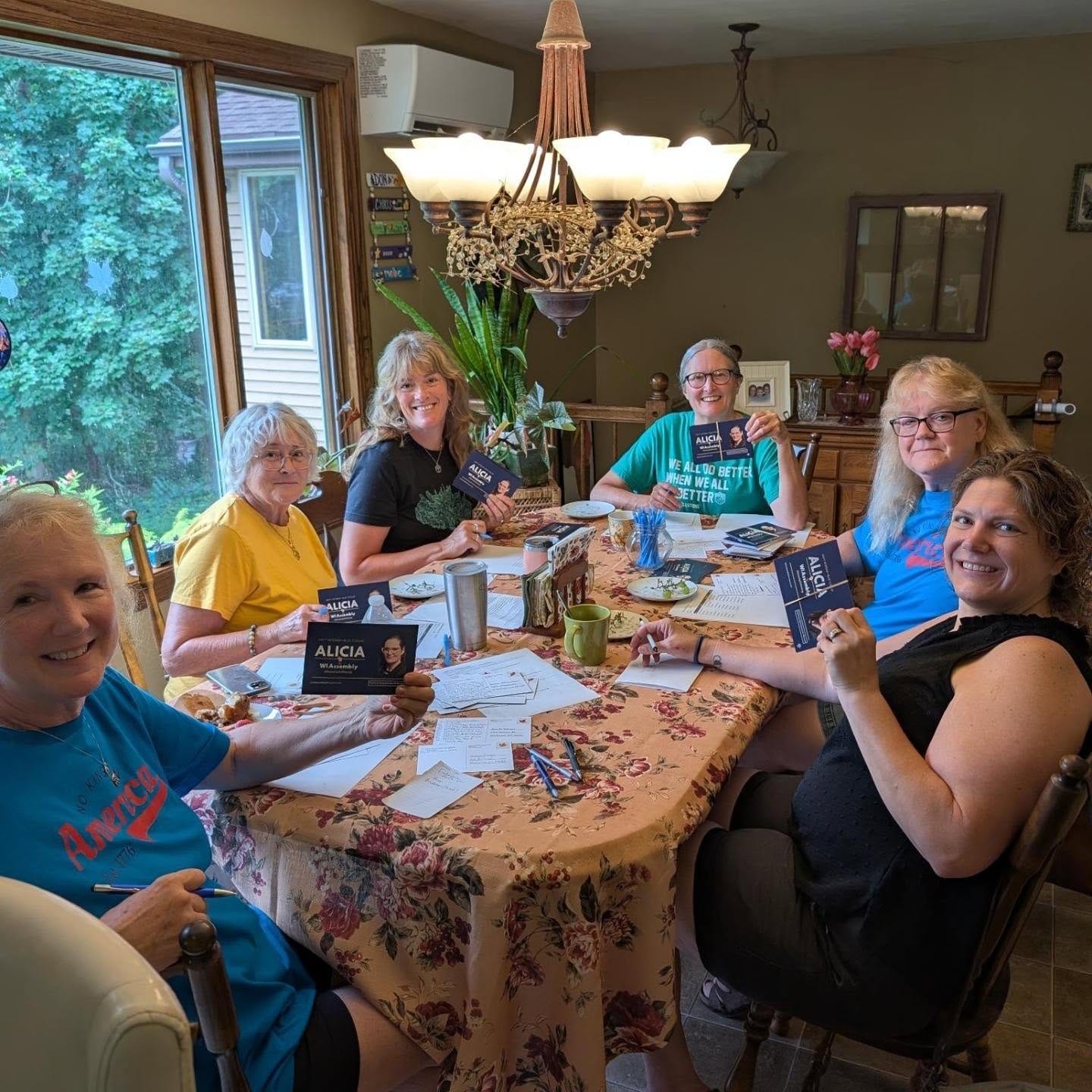
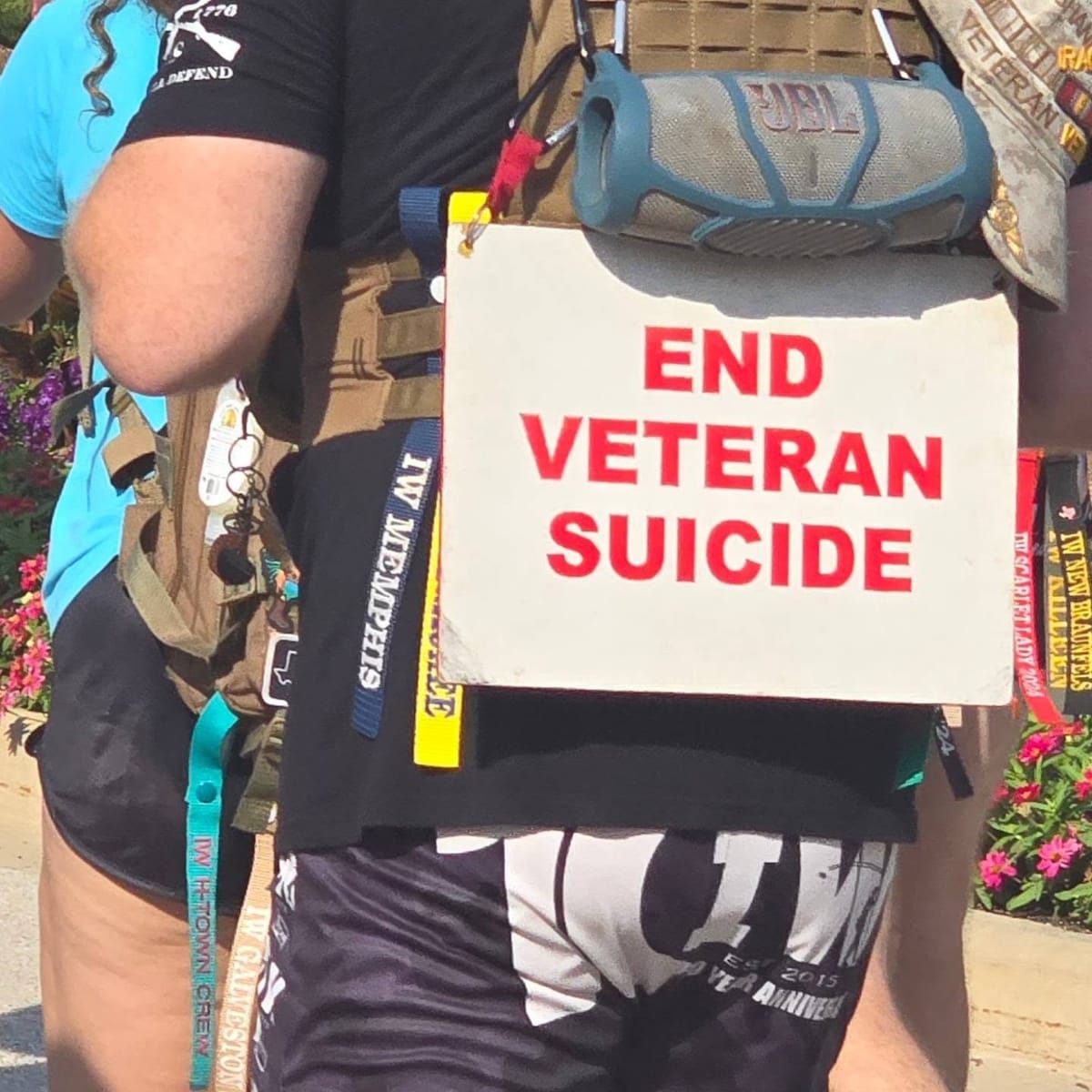
Left, supporters write postcards in support of Saunders. Right, Saunders is a fierce advocate for veterans' rights
Saunders says she can’t imagine the Democrats, if they get the chance, not passing property tax relief for vets, something that died in a Republican committee. Currently, veterans with a 100 percent disability rating can be reimbursed 100 percent of their property taxes at the end of the year. The bill that keeps getting stuck in committee would provide property tax relief down to those with a 70 percent disability rating or higher.
Saunders says veterans being misused or taken for granted is a fact of military life. Sometimes, though, it goes beyond what is acceptable. She sees the case of the USS Lincoln and its low morale and record deployment without a port of call during the Iran War as such a case, calling the President’s and Secretary of War’s recent comments toward the sailors “dismissive.” (See link to story below)
She has received the endorsement of veterans' groups, reproductive rights groups and unions, among others.
Farmers need help
With a mostly rural district to cover, getting out to certain people is difficult, Saunders says, which is why she attends a lot of events to meet and listen to voters and to let them know who she is and what she stands for.
She’s discovered a whole lot of frustration among voters, along with uncertainty over where to direct it.
“A lot of it is they're tired of it being political and a lot of people are like, whenever I talk to my representative, they just say, ‘Oh well, the Democrats. Oh well, the Republicans.’
"And I tell them, yeah, that’s kind of an irritating thing.”
What a lot of them don’t know until Saunders tells them is that the Republicans have held the legislature for 15 years, leaving Democrats unable to get anything done. Indeed, Democrats sponsored nearly 450 bills in the last legislative session. Only nine were granted a public hearing.
Though Saunders admits it’s frustrating to run into that level of political ignorance, she doesn’t begrudge them not knowing. As someone working so many hours a day in sanitation services, she understands.
“They’re working themselves to exhaustion just to afford to live, and then they come home, and the last thing they want to do is to turn on like WPR or Wisconsin Eye and sit there and watch an assembly floor session or community hearing,” Saunders says. “So it’s not coming at them like, you should know this. It is just listening to them and being like, yeah, I get where you're coming from. Because everybody has their own knowledge base and they have their own experience.”
The big issues for Saunders, along with veterans' affairs, are affordability, strengthening unions, addressing the financial straits of independent farmers, protection of farmland and water (which includes the data center matter), reproductive freedom, and human dignity and uplifting the LGBTQ+ community.
Saunders says she would push for a ‘right to repair’ bill that would make it possible for independent farmers and independent repair shops to fix complex farm equipment, something currently off limits because of digital locks manufacturers place on new farm equipment. It bars others from accessing necessary diagnostic tools or software available to dealers. With tariffs and deportations cutting into small farm labor, a right to repair bill could at least save farmers exorbitant equipment repair costs, she argues.
“We are working on getting some listening sessions in place (with small farmers),” Saunders says. “I don't feel comfortable walking out to their farm while they're in the middle of harvesting. Their life depends on the weather, and I do not want to interrupt their work. “I will listen to them because they are the experts. They’re the scientists in this. When you actually listen to people and you actually follow through with what they told you, they see that.”
Data centers on the ballot
Saunders says her opponent’s position on controversial data centers is all over the map. While he originally voted against tax exemptions for them, he voted for them in the 2023 budget, she points out. Sortwell, as a supervisor on the Manitowoc County Board, went against voters’ request for a complete moratorium on data centers in the area when he introduced an amendment that would allow data centers of up to one petabyte.
“But it does not limit acreage or electrical electric usage or water usage, so a data center like Cloverleaf could come in and say, ‘Oh, we'll just we're we're just going up to one petabyte, but they could go up and buy over 100 acres,’” Saunders explains. “And they could use that 100 acres and build on that and start drilling into the water table and drain the water, and then they could go and tap into the power grid and pull power and increase power costs for everybody in that area. Data storage is not the problem. Land usage and utility usage and water usage is the problem, as well as the noise and the dust and the pollution caused by the construction.”
Between that and his so-called anti-riot bill (that would have so broadly defined what a riot is that it would effectively have chilled free assembly) and his lone dissenting vote for expanding Medicaid coverage for post-partum depression, Saunders thinks Sortwell is vulnerable.
“Everybody’s like, ‘Hey dude, you should vote for this. It’s a popular bill,’” Saunders says. “And he comes back with, I won by 63 percent so I’m good. And he called it ‘daddy government.’”
Saunders says when she brings that up at the doors, voters respond in disbelief.
“They say, ‘what? He doesn’t like moms?’” she says with a laugh.
Saunders also thinks voters recognize – and appreciate – a candidate who understands the plight of the working class and the affordability crisis they are facing.
“I mean, at first they come at it as, 'oh, you're just a typical politician,’” she says. “And I tell them, well, no, I currently work in industrial sanitation, and I just got home from a shift and I didn't even have time to shower and I started work at four a.m. and I got home, like, ten minutes ago and changed out of my uniform. And now I'm here.
“And they're like, ‘oh, well, that is wild.’”


