


AASD Board votes to put $15M referendum on April ballot
Proponents argue that state neglect over per-pupil funding, inflationary adjustments and insufficient special education revenues to blame

Following months of public forums, citizen surveys and warnings from the Appleton Area School District over the consequences of inaction, the AASD school board on Monday voted to place a referendum on the April ballot asking taxpayers for $15 million dollars in each of the next four years to help cover the growing deficit in Appleton public schools.
The operational referendum follows by four years voter approval of a $130 million capital referendum. An operational referendum refers to everyday costs, such as salaries and benefits, maintenance, mental health services and costs such as utilities.
Referendums are used when school districts are unable to cover their operating expenses or structural needs. It shifts the burden of funding from state general aid directly to area taxpayers in the form of higher property taxes.
The AASD is facing a $13 million deficit for the current school year. Administrators have painted a bleak picture for the district’s future without support from the taxpayers – support, they argue, that should be the responsibility of a state legislature they say has been failing them for decades.
“This last (state) budget was just so devastating,” said Jackie Nider of Fox Cities Advocates for Public Education (FCA4PE). She pointed out the zero net increase in state funding. “Because we were on a fiscal cliff and got pushed over, and now we're like Wiley Coyote, and we're hanging by the branch.”
Advocates point to state neglect
FCA4PE and Friends of Appleton Schools have been on the forefront of the latest battle to shore up public education. Both groups – and other advocates for public schools – argue that the roots of school districts’ struggles across the state are obvious: a refusal by the state government to tie inflation to funding over the past two decades; a transfer of larger and larger portions of property taxes to voucher schools at the expense of public schools (property owners paid $900 million last year to fund private schools); caps on the amount of money a district can spend on a per-pupil basis; increased health care costs; and a state reimbursement rate hovering around 35% for special education – about half of what the state is obligated to provide. Voucher schools, on the other hand, receive a 90% reimbursement rate despite having no obligation to accept students that require special needs.
Among other area school districts, Menasha’s board also approved placing on the April ballot a request for $36 million for operational funds – $6 million in each of the next six years. School boards across the state this month will be voting on whether to seek referendums in the April election.
The surveys sent out to Appleton Area School district residents asked them if they would support one of four referendum amounts: $11 million, $13 million, $15 million or $17 million. Those survey takers who were opposed to any increases in taxpayer support were asked to prioritize from a list of potential cuts to school services, from closing schools to fewer classrooms to cuts to music and arts programs to fewer mental health services.
Oshkosh forced into tough choices after declining to seek referendum
The Oshkosh Area School District made manifest those AASD warnings when it voted on Jan. 9 not to seek an operational referendum in April. Because of its $5.5 million deficit for this year, OASD is proposing eliminating 44 full-time equivalent positions, including teachers and the Director of Technology; consolidating schools; increasing student-to-teacher ratios; and eliminating a half-dozen literacy support teachers.
James Bacon of Friends of Appleton Schools said while he was hoping the board would seek the $17 million option, he’s happy the board approved the second-highest total.
“I was hoping for at least $15 million, because I feel like it's not worth trying to shoot for only closing our current gap when we know things are continuing to rise at a rate that is not being funded,” he said. “And I would be worried that that $13 million would not be suitable by the end of the four-year period on its own. And I think it's not as exciting in many ways, to say, let's increase taxes just to keep us in the same situation.
“Like, why don't we try to increase taxes to do more for our kids in our community? And I think that's a message that is a lot easier and more exciting to rally around.”
Though Appleton district voters approved the 2022 referendum with a whopping 70% of the vote, Nider said she worries somewhat about voter fatigue.
“We’ve been passing referendums at record levels,” she said. “I am not convinced voters understand that it is a lack of state aid that is driving this need. But it is being driven by state budgets clearly. It’s large districts, small districts, red areas and blue areas.”
‘Our kids are not a line item’
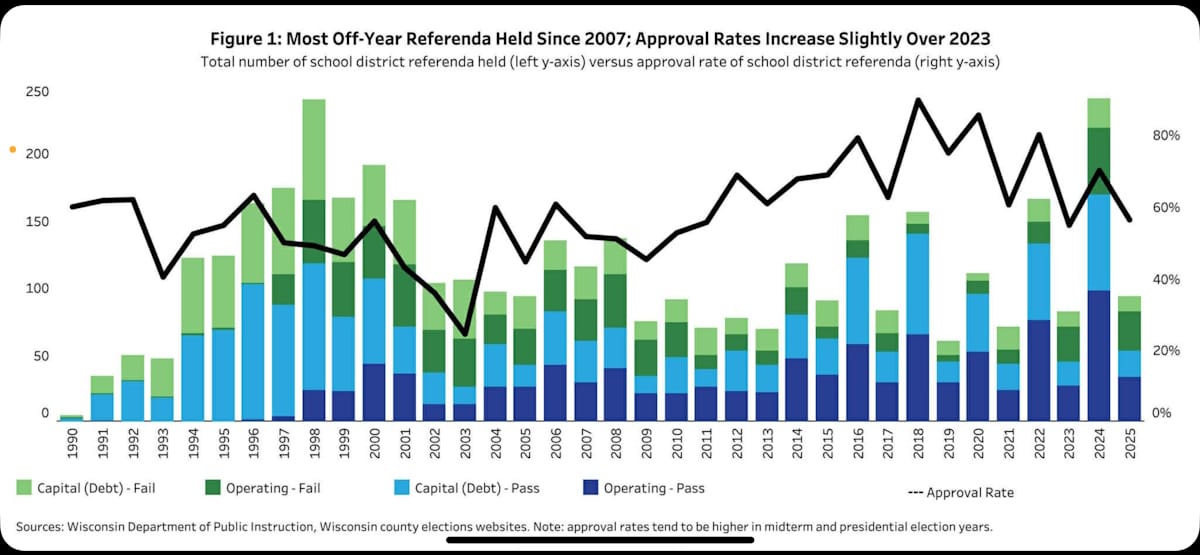
Last year, 86 of the state’s 421 school districts were forced to go to referendums. That’s more than one in five, but it’s even more significant when you consider that the in the previous year more than half (241) of all the state’s districts sought support from taxpayers through referendums. Voters approved 70% of those.
“These property tax increases are not by accident,” State Representative Lee Snodgrass (D-Appleton) argued at a press conference on Jan. 9. “They are the predictable results of legislative choices from the Republican majority party … for over a decade. Wisconsinites have already paid taxes to the state, understandably expecting legislative leaders like me and my colleagues to use those funds to support constitutionally mandated public schools.
“Our kids are not a line item in the budget,” she continued. “They are the most valuable resource Wisconsin has, and our legislature cannot continue to fail our constitutional obligation. We must support public schools and give them what they need.”
Gov. Evers on Jan. 13, sent a proposal to the state legislature seeking $1.3 billion in property tax relief, a restoration of the School Levy Tax Credit through which property owners are granted more relief (struck from the budget by the GOP), and a re-evaluation of the state reimbursement to public schools for special education after the increase from 30% to 42% in the past state budget failed to materialize and effectively sits at 35%.
"Given that the state has additional funds available,” Evers wrote to the Legislature, referring to the more than $4 billion state surplus, “I am calling on the Legislature to make the necessary investment to ensure that our agreed-upon percentages for special education funding of 42 percent in 2025-26 and 45 percent in 2026-27 are met.”
Snodgrass said she doubts Republicans would be willing to cooperate with Evers’ property tax relief proposal during an election year. State Sen. Kris Dassler-Alfheim expressed her frustration at the inability of the Legislature to give taxpayers what they want.
“It is indeed another example of how Democrats have been making direct efforts to help families in Wisconsin and how the Republicans stand with their arms crossed, pointing at the problem,” she said.
80% of survey respondents supported referendum
At a press conference on Jan. 9, AASD Superintendent Greg Hartjes pointed out the obligations and mandates for students with special needs placed on public schools from which voucher and private schools are immune.
“We are legally required to meet the needs of (every) student, and some students might cost $100,000 to meet their needs,” he said. “And then we look at voucher schools and their unwillingness to accept students with high-cost needs like that. It means that we have a higher percentage of students with disabilities that we're supporting. And then the other one is students who are learning English as their second language. That's another population that has a lot of needs.”
For Bacon of Friends of Appleton Schools (FoAS), the work now begins to educate the public on the need for more taxpayer support for public schools. He says he is confident that the referendum will pass even with potential fatigue over property tax increases. The surveys the school board sent out via a consulting firm came back with hopeful results. Nearly 80% of the respondents, he said, supported one of the four referendum proposals.
The difficulty, he said, is in explaining to taxpayers the intricacies of school funding which he says are by design meant to complicate matters. He admits that even he, an advocate who probably grasps the particulars as well as anyone, is still learning more about the nuances of the subject.
The push for a 'Yes' vote in April
So how will he and other advocacy groups go about pushing for yes votes in April? First, he said he thinks it’s important to emphasize to people questioning the finances of the district just how responsible AASD has been in managing what he calls an impossible situation. He noted that the district has been paying down its debt on past projects – including past referendums – in ways that have saved taxpayers millions.
“They’re doing that to minimize the impact on us taxpayers,” he said. “Especially knowing how much more strapped people are feeling than in the not-too-distant past. “And so, I think they’re really doing their part to try to lessen the burden on all of us.”
Beyond making that point – as well as emphasizing state neglect that is driving the financial crisis public schools find themselves in – Bacon said his group will be pointing out what is at stake.
“What does it mean if we vote yes?” he said. “And then the other part is getting out the vote and doing some social media work. We have a website where people can volunteer or to put up a yard sign or help in other ways. And then, probably one of the biggest ones is just trying to get people to contact ten of their friends and family and their network, and just again, make sure that they know how to get access to information, to educate themselves on the issues surrounding the referendum, and then just to remind them to vote yes.”
AASD Board votes to put $15M referendum on April ballot © 2026 by Kelly Fenton is licensed under CC BY-NC-ND 4.0


