


Providers, families worry what happens next now that childcare support has come to an end
The Child Care Bridge Payment Program, which extended childcare stabilization for a year after the end of Child Care Counts, ends on June 30.

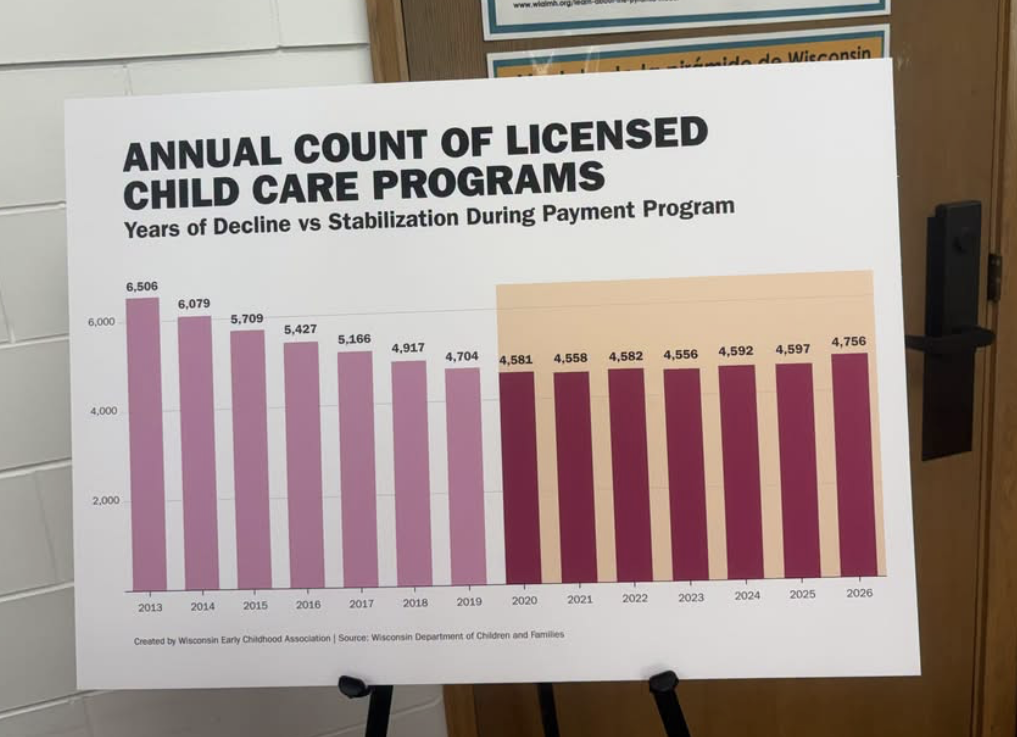
Data on display at a press conference on Monday at Bridges Child Enrichment Center revealed the impact of childcare subsidies on the industry over the past six years. The number of providers had been on a steady decline, while the ones which remained open operated on the thinnest of margins even while parents struggled to pay as much as $18,000 a year for one child and employees tried to get by on annual wages of as little as $28,000.
Starting in 2020 pandemic relief infused states with massive financial support. Wisconsin devoted $750 million of that to help shore up childcare through the Child Care Counts program and the results were undeniable as not only did closures abate but the number of providers actually began to grow.
When the money for Child Care Counts was used up, Republicans rejected Democratic efforts to extend the program indefinitely but finally agreed to use remaining ARPA interest money to create the one-year Child Care Bridge Payment program. Now that is coming to an end and everyone on hand Monday – providers, parents and Democratic lawmakers – agreed that, without action, a crisis looms.
Forced to increase tuition
Nicole Seebruck Zellmer, the executive director of the Bridges Child Enrichment Center for the past two decades, warns of increased tuition costs, staff reduction, fewer children being served and the further closing of childcare centers. Zellner stressed that the past five years of subsidies have not gone toward anything other than keeping doors open.
“They have gone toward the things that make quality early care and education possible every single day,” she said. “They have allowed us to maintain lower child-to-staff ratios, giving our teachers the time and capacity to truly meet each child's individual needs. They have funded professional development and coaching and helped us strengthen staff retention and prevent burnout by creating a healthier workplace where teachers feel supported and can build lasting relationships with children and families.
“Just as importantly,” she added, “this funding has prevented tuition from rising even further out of reach for middle class families. Every day, I talk with parents who are already struggling and making difficult financial choices, yet we are now being forced to increase our rates another ten percent just to break even and remain open as the bridge program payments come to an end.” Seebruck Zellner said her center is facing a potential loss of $100,000 in annual revenue.
Cradles to Crayons Learning Center owner Julie Stoffel agreed, stressing that Child Care Counts prevented a complete collapse of the industry. She noted that the cost for an infant runs around $350 a week, which, while prohibitive for many families, still barely pays the bills.
“The math isn’t working,” she said. “And as those funds disappear tomorrow, providers are left with impossible choices: raise rates on families who can't afford it, cut staff, reduce access or close our doors. None of these options work for families, for businesses, for our economy. We know what works. We've seen it. The question is whether we're willing to do it as a community.”
Julie Stoffel of Cradle to Crayons Child Care
Childcare's impact on child development
During state budget negotiations last summer, Democrats proposed nearly $500 million in ongoing support for childcare as Child Care Counts ended. In an e-mail response Sen. Rachael Cabral-Guevera (R-Appleton) pointed to the compromise reached between Republicans and Gov. Tony Evers – The Child Care Bridge Payment Program that ends June 30. She noted as well the boost in Wisconsin Shares, which provides childcare subsidies for lower-income families, and funding for an early-school readiness program.
While providers were relieved for the one-year extension, they argued at the time that the compromises failed to address long-term solvency and cost issues.
Hilary Miller-Goldwater, a professor at Lawrence University, says losing access to Bridges Child Enrichment Center would be devastating, likely forcing her to quit her job and denying her son critical developmental opportunities.
“I know the importance of childcare, and I need to reiterate all the benefits of it for infants, like social development, intellectual development, emotional development,” Miller-Goldwater said. “There's a lot of research on this. Through attending Bridges he's really grown a lot socially, like just being able to interact with kids, being able to have this really small-child teacher ratio with an infant room. He's really social around other kids, his language has already been improving quite a lot.
“I just can't imagine the way that this will affect parents, both the amount of money they're going to have to pay for childcare, as well as being concerned that the child-teacher ratio might change, and that's really a fear.”
That’s for those which survive. Tracking surveys by the Wisconsin Department of Children and Families (DCF) and the Wisconsin Early Childhood Association (WECA) estimate as many as 1 in 4 providers will go out of business as a result of the loss of funding. For Seebruck Zellner of Bridges Child Enrichment Center, it has meant raising tuition eight percent and anticipating another increase of anywhere from seven to 10 percent.
“That's really to maintain status quo,” she said. “That's not to give our staff salary increases, that's probably not even taking into account the increases in utilities and rent and everything else.”
States such as Vermont and Connecticut have found creative ways to fund childcare. In Vermont a dedicated payroll tax, paid for mostly by the employer, as well as tax credits for childcare, have helped stabilize the industry. Connecticut and New Mexican have each created endowment funds.
'You can judge a society on how well it treats its most vulnerable'
Sen. Kris Dassler-Alfheim (D-Appleton) sees outreach to businesses as one possible solution.
“I think that manufacturers agree with us when we meet with them,” she said. “The number one problem they have is access to childcare, followed closely by housing and health care, all issues that we, as a party, are trying very desperately to address. It is something that we have to coordinate, that we have to work together on. We all agree the problem exists. It's now time to take action together to actually fix it.”
Rep. Lee Snodgrass
However it might ultimately be funded, Rep. Lee Snodgrass (D-Appleton) insisted Wisconsin can’t afford not to find a way, pointing out that it provides critical support for employment and the economy, in addition to providing important early childhood development. She called childcare "a foundational component of the state's economic infrastructure, enabling parents to work, employees to retain their employees, and communities to function.
“Now more than ever, with families and businesses struggling with the high rate of inflation, food costs, fuel, utilities, materials, and insurance costs rising, providers are no different than the rest of us, and their wages are remaining stagnant,” she said. “The legislative Republicans' failure to ensure childcare bridge payments is ongoing means that we have doubled down on the cost and the crisis to families and providers as they are facing difficult circumstances. Next session, we will make children and families a top priority. You can judge a society on how well it treats its most vulnerable, its oldest, and its youngest.”


