

Court restores Act 10 though decision faces near-certain appeal to state Supreme Court
The Appeal Court’s majority decision, signed by conservative Judges Mark Gundrum and Shelley Grogan, argued it was not up to the court to second guess the reasons the legislature included some public employees and not others.


The controversial Act 10 legislation enacted 15 years ago under then-Gov. Scott Walker has been restored for now.
In a 2-1 decision, the Wisconsin 2nd District Court of Appeals overturned a lower court ruling by Dane County Circuit Judge Jacob Frost in December 2024 when he ruled Act 10 unconstitutional, saying it violated equal protection by exempting some public safety workers. Frost stayed his ruling almost immediately, keeping the law in place ever since.
The Appeal Court’s majority decision, signed by conservative Judges Mark Gundrum and Shelley Grogan, argued it was not up to the court to second guess the reasons the legislature included some public employees and not others. “We can conceive of facts for the public safety distinctions, and we can hypothesize a sound reason for why some public safety employees were not included in Act 10’s public safety group,” they wrote. “Namely, the groups included in the public safety group were the minimum number of groups the Legislature deemed essential to perform public safety-related services, and it selected employees it determined were necessary to maintain public safety in the event of labor unrest.”
Act 10, signed into law on March 11, 2011, limited collective bargaining to wages, but only up to the rate of inflation, and stripped unions of the right to negotiate working conditions and benefits such as paid time off and health insurance. The law requires public sector unions to hold annual recertification votes, with a majority of all members (not just those who vote).
Judge Lisa Neubauer, in her dissent, wrote, “To pass constitutional muster, there must be something inherently different between the two groups whose members are all engaged in public safety — active law enforcement, fire suppression and prevention, and emergency services — dangerous jobs that require a high degree of conditioning. Employees who perform the same types of services and are putting themselves in harm’s way are being treated dramatically differently under the law.”
Neubauer pointed out that the unions whose bargaining rights were not curtailed by Act 10 had all supported former Gov. Scott Walker's campaign.
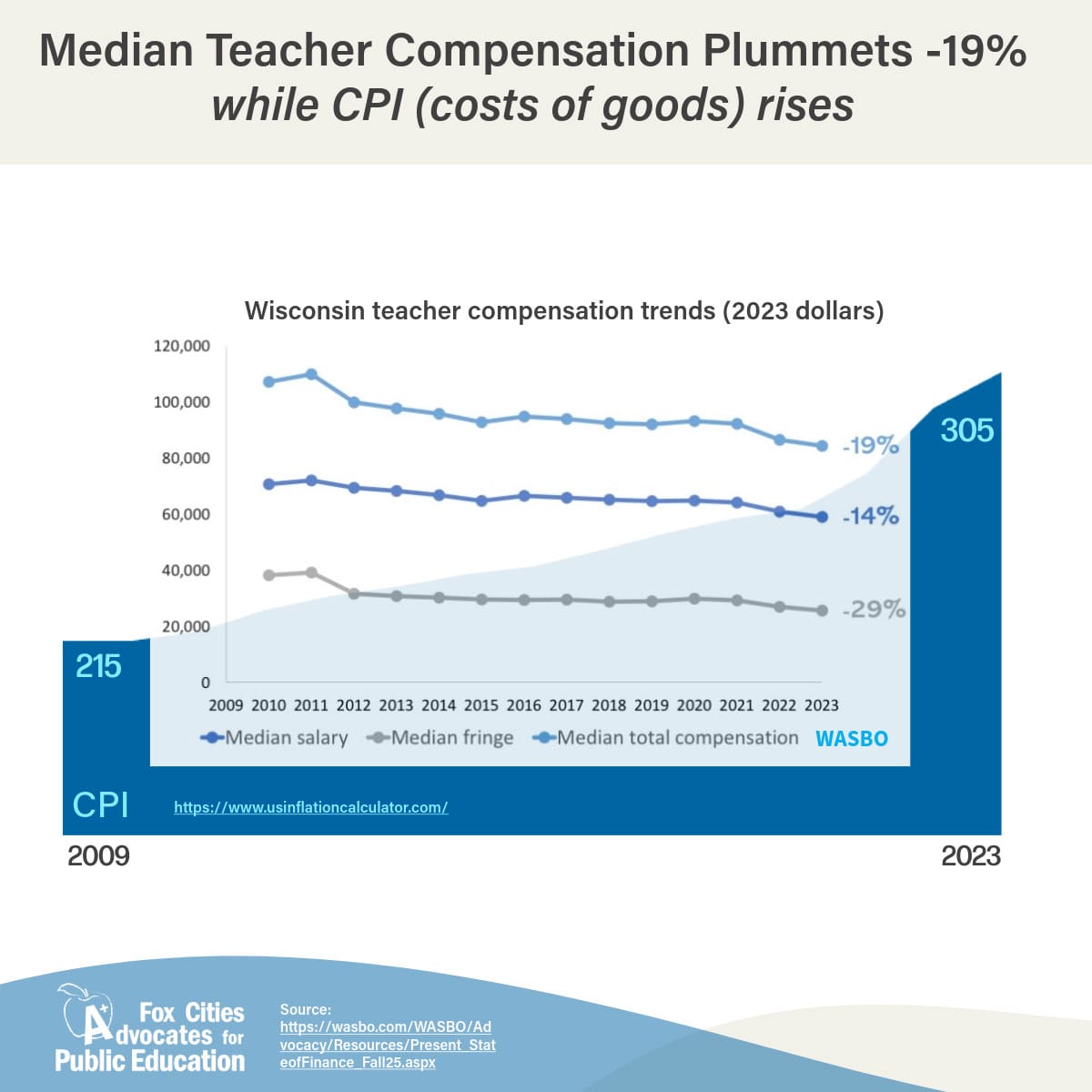
The lawsuit to overturn Act 10 on the grounds of unequal protection was filed in November 2023 by a group of unions citing low pay, staffing shortages, and poor working conditions. Based on research by Anne Chapman, Research Director of the Association of School Business Officials (WASBO), median teacher compensation has plummeted by 19% since 2010, significantly impacting the ability to attract and retain educators.
Next stop - the Wisconsin Supreme Court
“While I’m disappointed in the Court of Appeals’ decision, I look forward to the next step: the Wisconsin Supreme Court,” said Corey Otis, President of the Appleton Education Association. "We are confident justice will soon be served.”
The Wisconsin Supreme Court will have a 5-2 liberal majority when Chris Taylor is sworn in on Aug. 1. Conservative Justice Brian Hagedorn has said he would recuse himself from hearing the Act 10 lawsuit since he served as chief legal counsel for former Gov. Scott Walker when Walker introduced and signed the controversial law.
“Wisconsin is better when all employees have a say in our workplaces, whether about class sizes in our schools, safety on the job, hours or any other number of areas,” said the union plaintiffs who sued to restore collective bargaining rights to Wisconsin public service workers. “Public service workers across the state won’t stop until we regain free, fair and full collective bargaining rights to negotiate with our employers.”
Plaintiffs in the case include SEIU Wisconsin, Abbotsford Education Association (WEAC/NEA), Beaver Dam Education Association (WEAC/NEA), the American Federation of State, County and Municipal Employees (AFSCME) Local 47, AFSCME Local 1215, Teaching Assistants Association (TAA/AFT Local 3220), and Wisconsin Teamsters.
Court restores Act 10 pending near-certain appeal to the Wisconsin Supreme Court © 2026 by Carol Lenz is licensed under CC BY-NC-ND 4.0


