

Abitz taking on run in deep red district with sense of purpose, joy and fearlessness
She's hoping dissatisfaction with the status quo and her own rootedness in the area and ability to connect can overcome natural disadvantages she faces


If you think a Democrat’s road to Madison from deep red Assembly District 56 is tough, try getting there on a skateboard.
Grace Abitz did that 10 years ago when she and four friends – on a lark – hopped on their skateboards in the Fox Cities and cruised down back roads and country highways, arriving in Madison some 15 hours later.
“We were on (Highway) 26 for part of that,” Abitz says. “That was a little uncomfortable. But I knew I could do it and I wanted that adventure.”
The 13th anniversary of her day-long jaunt to the Capital fell on Aug. 11, the day of the recent state-wide primary. Abitz won, setting her up for another run at Madison, which, given that AD56 has been perpetually hostile to progressive candidates, might make that skateboard seem more like a limo.
But, as with that skateboarding adventure, Abitz is approaching her latest endeavor with fearlessness and joy, though she also admits to feeling a sense of urgency as well. For 16 years, Republicans have held both the State Assembly and the State Senate. The Senate seems likely to fall to Democrats in the Nov. 3 election. The Assembly is up for grabs.
“I'm happy to be doing this,” she says. “Do not get me wrong. It's the last line of defense we have right now. But it is very exciting for me. It's like a big scavenger hunt, and just building all those connections. I refer to them as seeds. Emily and I have been planting seeds since 2022.”
Emily Tseffos, who is vying for State Senate this year, ran for this seat in 2024, spending months talking to voters – mostly Republicans – who had never had a visit from a Democratic candidate before. While Tseffos lost, she made inroads, convincing even some Trump supporters to support her after holding earnest conversations and finding common ground. Now, Abitz hopes to reap the harvest of seeds sown in slightly-less-barren soil.
“When I was canvassing in North Appleton, a lot of people in that neighborhood knew who she was,” Abitz says. “They didn't necessarily know who I was, but once I made the connection (to Tseffos), they were, like, ‘Oh, okay, we got you too.’ They trust her. So they trust me by extension.”
Voters aren’t happy
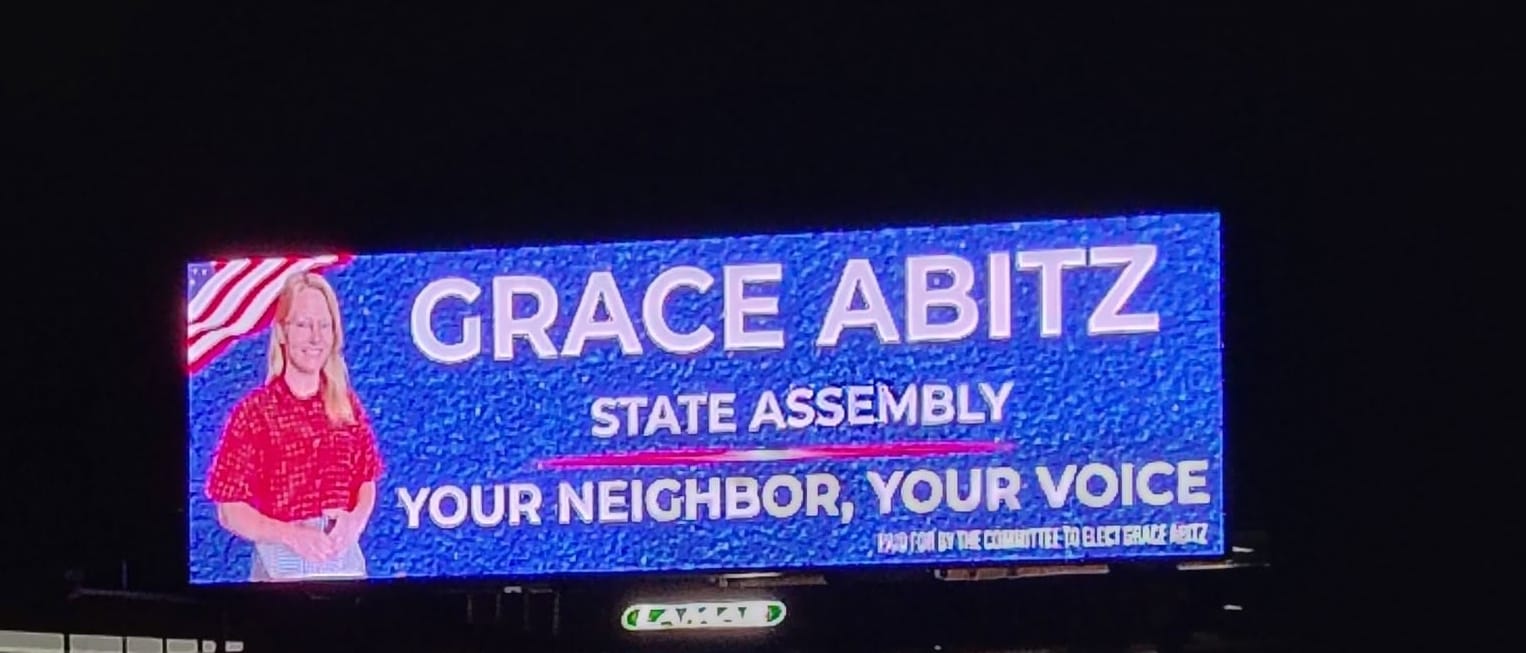
AD 56 runs from just south of Clintonville east to near Seymour and south to Grand Chute, Greenville and the north side of Appleton. The Republican candidate has won by 18 points or more in each of the past four elections. The district became decidedly more Republican following the 2023 redrawing of the state maps.
While the odds seem stacked against her, Abitz has some winds blowing in her favor. She is running for an open seat against Dr. Anthony Phillips, who has never held office. Phillips lost two years ago in the State Senate 18 race. She is running in a year of near historic dissatisfaction with the Republican Party. Wisconsin voters are enduring higher prices, increased health care costs, higher property taxes, underfunded public schools and a childcare crisis. The GOP has held the State Assembly and State Senate the past 16 years and has opted not to use the state’s $3 billion surplus to address those matters.
And looming in 2027 are increased burdens on the state when HR 1, the GOP’s so-called ‘One Big Beautiful Bill,’ really kicks in with federal cuts to food benefits and Medicaid.
Another point in favor of Abitz is her deep roots in the district (some folks still bring up her Grandpa Bill and Great Grandpa Willie) and her time on the Hortonville Village Board, which not only gained her name recognition and experience in governance, it made her a fearless canvasser.
“Yeah, it plays into what I'm doing today,” Abitz says. “It was an equally important race, much smaller, but it still felt big at the time, and it was. I don't know if shameless is the right word, but as far as canvassing goes, you really need to just be kind of shameless, and (assume) everyone's available for a conversation. Don't think about it too much. They'll decide what they're ready for.”
Rooted in the community
Grace Abitz grew up in a conservative household in Grand Chute across the street from Fox Valley Tech and went to St. Paul’s Lutheran and Fox Valley Lutheran. She earned a degree in Environmental Design at UW-Green Bay. It was while at college she decided to tell her parents she was gay. It did not go particularly well. That experience, she says, has made her much more aware of how important acceptance is.
“I will be a good friend to anybody unconditionally,” she says. “I have plenty of trans friends, and the way that they're weaponized right now is super frustrating because it's such an empty conversation and it's rooted in chosen ignorance.”
In 2016 she and her partner opened Alley Cat, a charming coffee shop in the middle of the Hortonville business district. The business has even more deeply rooted her in the district. And as a business owner she thinks it makes her more relatable to conservative voters.
“It's tough because as a small business owner, we definitely pay beyond a fair share of taxes for the amount of income that we make,” Abitz says. “I would like to see the whole tax situation get flipped on its head. I tell people in every conversation, you and I are paying way too much in taxes. I want to support public schools. But I think the conversation for me is always going to be about taxing wealthy corporations fairly.
“That's the crux of this all the time. It's super boring but you have to follow the money. That's why we are in this situation that we're in.”
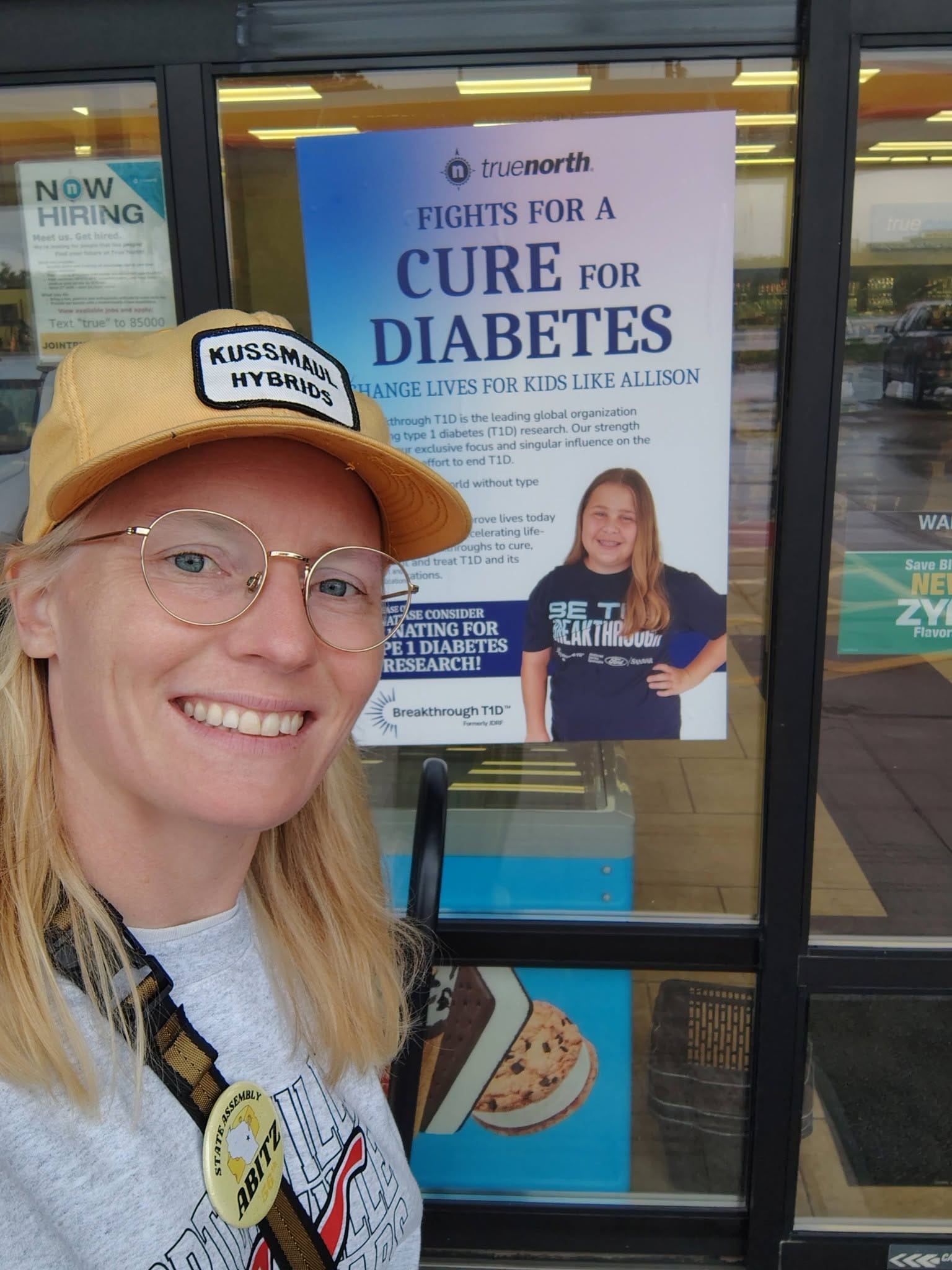
That’s just one way Abitz can connect with voters in the district. She also has been a Type 1 diabetic since she was an infant, something she shares with two of her siblings.
“When I was 26, getting insurance through United Health, I had over a $400 premium and my partner at the time had a $500 premium,” she says. “So it's like, well, we just started a business. We're working 70-hour weeks, and we're paying close to $10,000 a year to health insurance.”
Abitz mentions a senior woman in Ellington who is barely getting by and has to care for a disabled son who requires 24-hour-a-day daycare. Medicaid is their lifeline and HR 1 cut nearly $1 trillion from the program. The impacts of that will fall on states – and possibly, on this woman and her son – at the first of next year.
“I can empathize with people needing their medications at an affordable price,” she says.
Expansion of BadgerCare (the state’s Medicaid plan) is one of Abitz’s top priorities.
Higher prices, higher taxes plague voters
Affordability, public education and the child care crisis are also among Abitz’s top concerns. Child care industry experts consider the state to be in a cost and availability crisis, impacting businesses, workers and their families, and the overall economy. Democrats have proposed direct subsidies, similar to the Child Care Counts program that was funded with ARPA money during the pandemic. Most independent child care center operators credit those subsidies with saving the industry from imminent collapse, allowing them to open up more slots, raise pay for staff and, in some cases, help lower costs for families. For their part, Republicans, including Abitz’s opponent, are opposed to state subsidies and recommend market-based ideas and de-regulation instead.
The issue that most frustrates Abitz, though, is public education. Starting in 1993, the state instituted a per-pupil funding formula that included revenue limits. While it at least initially allowed for increases to account for inflation, that ended in 2009 and districts have fallen further and further behind, ultimately leaving it up to local property owners to help close the gap.
“I think the easiest issue is getting public schools where they need to be at,” she says. “I think you fix that and then it’s not just this talking point like it’s been for the last 15 years. That drives me nuts, that this is still an issue this election cycle. You’ve got to call out these representatives. You guys all were complicit in this. That just blows my mind.”
‘We’re capable of so much’
These are the things she tries to impart to voters of all persuasions when she’s out on doors. Sometimes, she says, she only gets 10 seconds with a person, but she can read if a person is game for a real conversation. People, she says, are mad about the war. One voter in Mosquito Hill had recently lost a brother in the Iran War. People are angry about taxes. She explains to them how shared revenue (the money the state is supposed to send back to municipalities) had been frozen for nearly 20 years, forcing an increasing in property taxes to keep up with municipal services. Act 12 in 2023 began to release some of those state funds again.
Abitz believes her job is to give voters one reason to vote for her.
“This is a numbers game at the end of the day, all the time,” she says. “We have to talk to people. If they are bothered that you tried to canvass them, that's on them. But there are the ones who say, ‘Oh my God, thank you. I just didn't know about this.’ Those are the most satisfying. You just have to give them one reason, and that might take literally five seconds. Yeah, and then they go vote.”
And there are the voters who are naturally suspicious of anyone coming to their door wanting to talk about, of all things, politics. Their reticence deepens when they find out that the person standing in front of them is a politician. Abitz persists nonetheless. She thinks this is the way to, if not winning an election, to healing. She recounts one such interaction that reminded her why this work matters.
“By the end of it, after 20 or 30 minutes of talking, he just said, ‘You look like a good person,' and he took all of the candidate info. I think if you fight for your values, and you show people that you’re here because you care. Like, I'm not here because I'm trying to enrich my own life. That's not why you would do this. I think a person runs for this office because you're looking out for your future. I have a little niece and a nephew. I want everyone to have equal rights, and there's so much instability right now.
“I mean, I would die to have some just boring predictability where we're not thinking about elections all the time.”
It comes back to that skateboard ride when she was just 21 years old, when Abitz tapped into a truth she thinks applies to our humanity, even to our politics.
“I honestly tell people it's my favorite day of life ever,” she says. “It was perfect. People have so much untapped energy. We're capable of so much. I'm not suggesting everyone moves across the countryside on a skateboard, but it just shows you what humans are capable of.”


