

The time is right to enact living wage legislation, coalition says
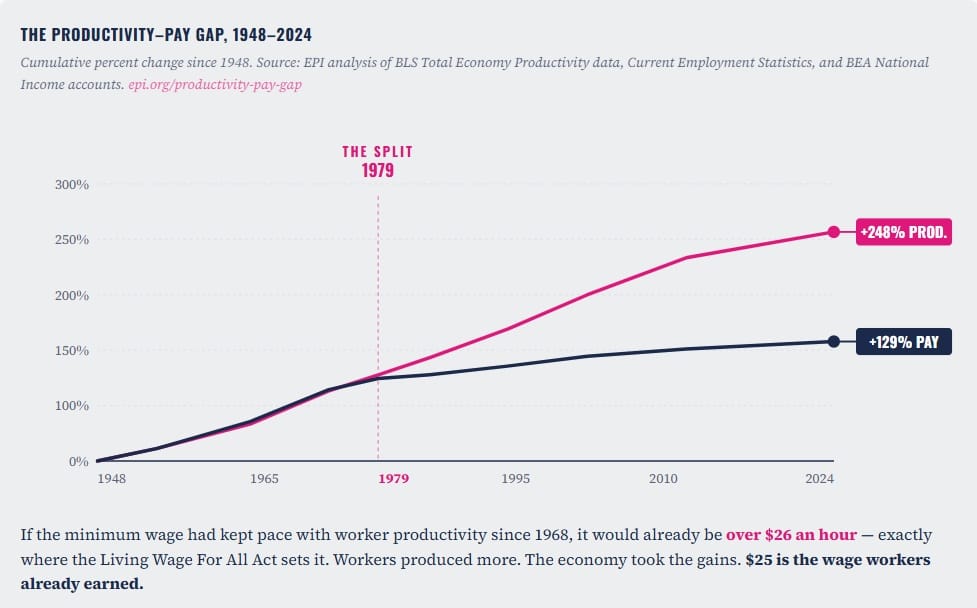
Had wages grown commensurate with productivity gains the current minimum wage would be $28. Had it kept pace with the growth in CEO pay, it would be $35.


About halfway through his presentation during the Living Wage Coalition’s tour stop in Appleton this week, Peter Rickman promised he was about done quoting numbers and stats.
Yet it was in those numbers that the full weight of workers’ economic losses over the past half century could be most fully felt and understood.
To take one shocking number, for example, the Rand Corporation estimates that the end of New Deal economics, which from 1935 to 1975 gave workers’ bargaining power and assured worker wages were in line with productivity, cost workers $79 trillion dollars in lost wages.
“That number is so large it is quite literally unfathomable,” said Rickman, President of the Living Wage Coalition. “That comes out to $28,000 per year per worker over the last four and a half decades. Politicians governing our political economy, through their action and inaction, those folks deciding on economic power, took $28,000 per year from you.”
Rickman itemized the way in which the middle class would be different today: better retirement, affordable health care, a family vacation and, in general, less economic stress along with a more decent and dignified life.
Rickman was on hand at the Appleton Beer Factory not just to itemize worker losses but to dispel myths, identify the minimum hourly living wage, and discuss the history of workers’ rights as well as identify next steps toward rectifying what he sees as 50 years of pure corporate greed and political neglect. Rickman is also President of the Milwaukee Area Service and Hospitality Workers Union and a lifelong and enthusiastic supporter of workers’ rights.
“Wisconsin used to be a high-wage state when half the working class punched the clock in factories and foundries building autos and agricultural equipment, working in packing houses and paper plants,” he said. “It was a place that birthed and built the world's first mass middle class. But those jobs are gone, and they ain’t coming back thanks to trade deals like NAFTA and the WTO, Wall Street and big multinational corporations. Thanks to deregulation of big banks that financialized our economy and traded production for financialization.
“They've been replaced by an explosion of low-wage, no-benefits, no-rights, no-respect, non-union jobs.”
The Living Wage Coalition came together on Labor Day of last year to call on state lawmakers to adopt living wage legislation. In February, 43 Wisconsin state legislators – all Democrats – introduced bills that would raise the minimum wage to $20 an hour by 2030 and index the minimum wage to inflation going forward.
On May 1, the coalition, with the support of three Gubernatorial candidates – including David Crowley – launched a one-year campaign to urge the new Governor to sign that bill by May Day 2027.
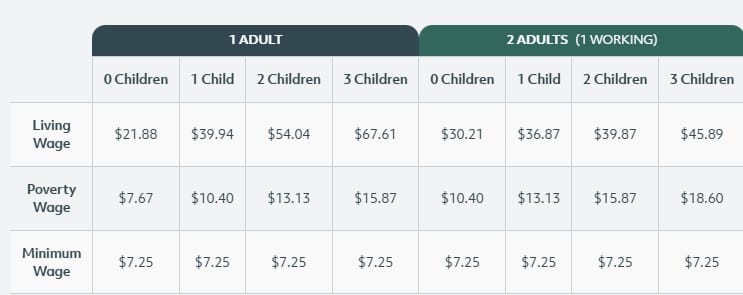
In Outagamie County, a living wage is estimated to be a little more than $21 an hour.
‘Not only is it affordable, it’s morally right …’
Rep. Lee Snodgrass, one of the co-sponsors of the February minimum-wage legislation, argued that businesses would be able to absorb the costs of a living-wage law through incremental implementation, starting with an initial increase in the minimum wage from the current $7.25 an hour to $15 and a tentative timeline of reaching $20 by 2034.
“Henry Ford famously raised worker wages back in the day an additional $5 an hour and said at that point that it was the most effective cost-saving act that he ever did,” Snodgrass said. “It increased retention. It increased productivity. This bears out in all the studies as well.
“When you pay people value for the work that they're doing, they feel good about it. They feel prideful in it, and they work harder. Not only is it affordable, it's morally right, and it's actually going to improve the economy.”
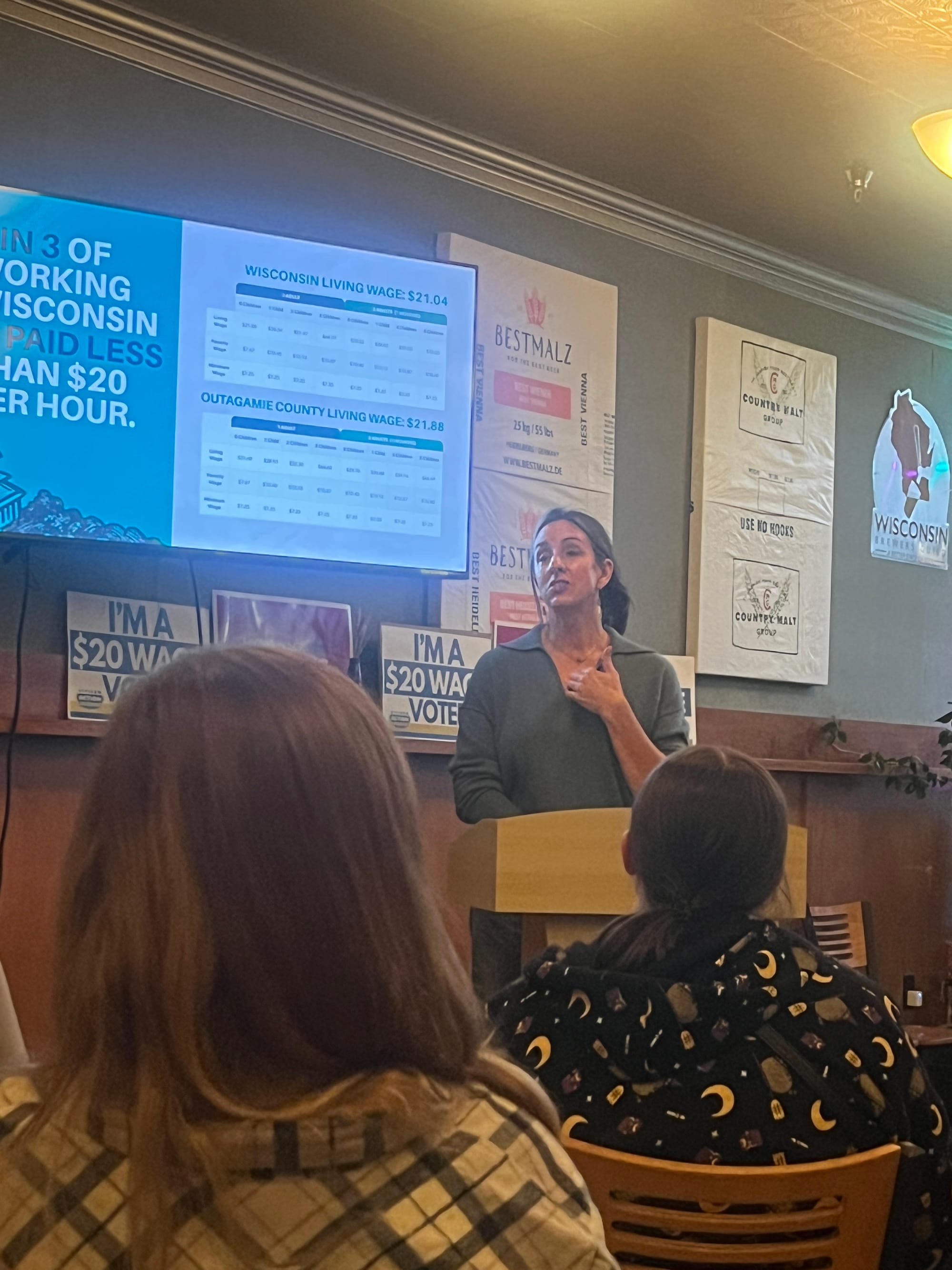
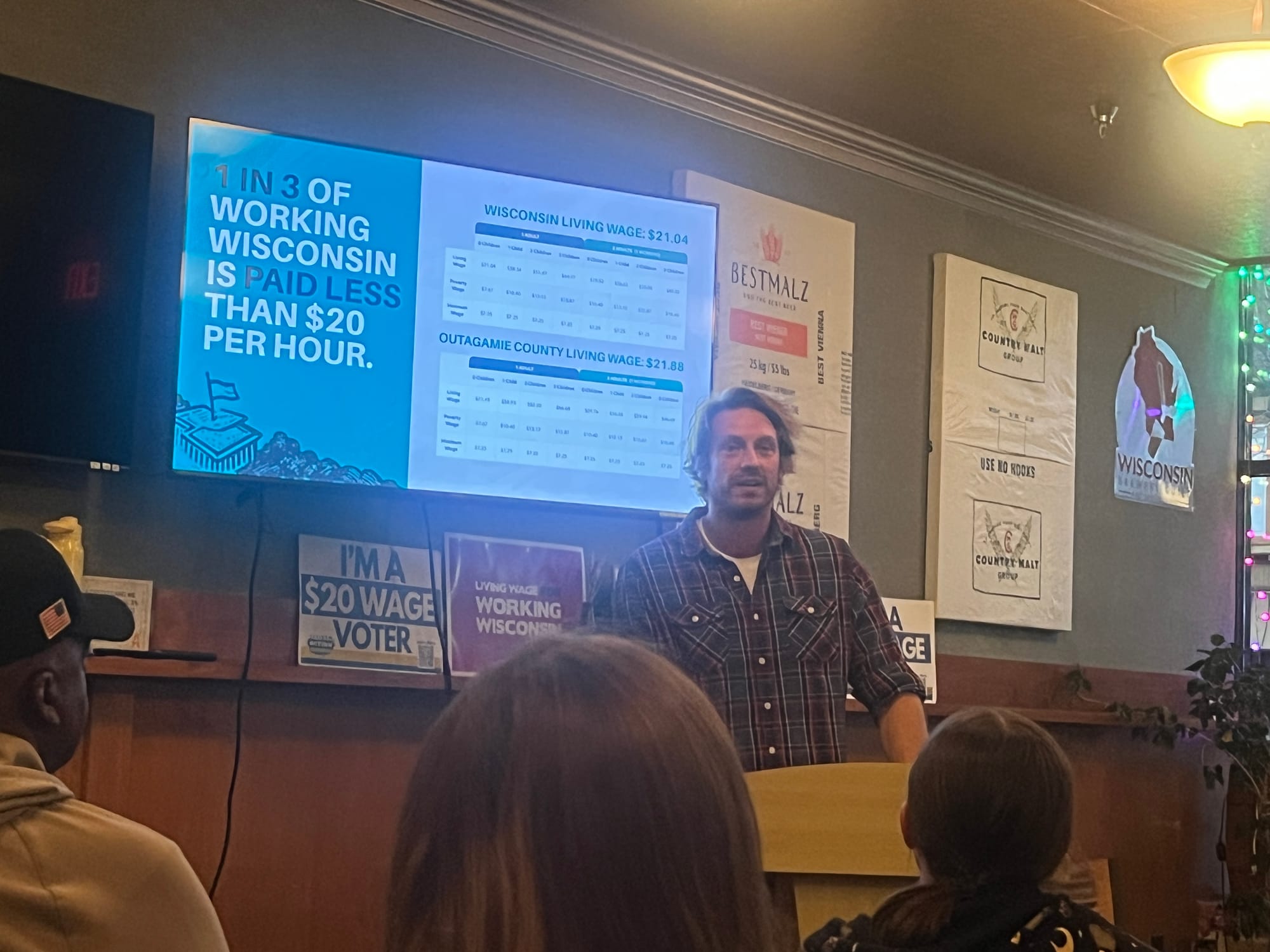
State Representative Lee Snodgrass and Peter Rickman, President of the Milwaukee Area Service and Hospitality Workers Union, speak at a Living Wage Coalition presentation at the Appleton Beer Factory on Oct. 21.
Seven of the 10 fastest-growing jobs in the state pay less than a living wage, Rickman pointed out, and 14 of the top 20, calling Wisconsin “a low-wage state in a low-wage nation.”
Rickman presented a graph that described a sideways V, the top line, expanding ever upwards, representing corporate profits and the bottom line extending in the opposite direction, depicting the declining share of national income going to wages. Wages are, he said, one-fifth below the level they were 50 years ago, while that share going to corporate profits is two-and-a-half times greater.
Rickman argued that the impact of a minimum wage that hasn’t been increased in 17 years is most felt by the way it stagnates median income. Had wages grown commensurate with productivity gains, he said, the current minimum wage would be $28. Had it kept pace with the growth in CEO pay, it would be $35.
“This wasn't some accident that happened,” Rickman said. “Nobody waved a magic wand. This was deliberate. The system was rigged. This is a story of economic power. It's a story of labor market bargaining power, and a story of how our democratic republic constructs the political economy, how it shapes markets, and for whom.”
Rickman blames presidents from both parties for either openly working against workers or for failing to modernize labor laws. The number of workers represented by unions in Wisconsin has fallen to 10 percent, numbers, he pointed out, that are actually worse than during the Gilded Age at the turn of the 20th century.
Dispelling myths
In addition, corporations and industries are reaping higher and higher profit margins, meaning workers are also paying more in addition to making less money. In 1980, corporations set margins of around 21 percent. Today that number is closer to 60.
“Not a dime of that has gone into higher wages,” Rickman said. “It's all gone into corporate profits. Power in the hands of the boss class has been so concentrated that they can not only keep wages flat but actually start taking our pay away from us.”
Democratic Congressional candidate Rick Crosson called for “good old-fashioned trust busting.” He said nobody envisioned the disparity in wealth we see today.
“In 1890, Senator John Sherman from Ohio got down on the Senate floor and gave this impassioned speech, saying that what we needed to do was end the tyranny of what we would call today the oligarchy, the kings over the necessaries of life, and we passed an antitrust law that explicitly said big is bad,” he said.
Rickman said most of the arguments against raising the minimum wage – it will increase prices, it will cost jobs, etc. – are based on pure myth. When Seattle and New York doubled the minimum wage, he pointed out, “every single credible study” showed no loss of jobs. As for it being inflationary, he said, “Researchers have found that if there was a 10 percent increase in the wage floor, price increases in those sectors impacted by it are about 0.5 percent so that a $10 item goes up to $10.5. It's not even nickels and dimes. It's literally just one nickel.”
The idea of creating a living wage is more popular than ever, Rickman said, crediting Bernie Sanders’ populist movement a decade ago for its 60 percent favorability today.
“This is the kind of thing where people are with us because they recognize we are getting screwed,” Rickman said. “They know the folks at the top are taking it from us.”
Next steps
So what’s next? Gloria DeGrave with Citizen Action is working with the Living Wage Coalition to mobilize citizens through grassroots organizing and through outreach to legislators. They are currently out talking to voters about the issue and urging them to contact their legislators. She said monthly strategy meetings will begin the first of the year. And they will be recruiting candidates to run on a living-wage platform, especially if they can repeal the current limitations set on municipalities from creating their own minimum wage laws.
“When we do that, we will need people in those seats that will be committed to a living wage,” she said. “That means running for local city seats. It means running for local county seats. But a lot of times, we cannot find a challenger that is interested in putting forward things like a living wage on those lower seats. We need people that are willing to go and do that and be committed.”
Rickman said it’s time for legislators to embrace the New Deal mindset that promoted collective bargaining and a fair return for labor.
“We took our share for 40 years,” Rickman said. “We made sure that workers had economic power, and we made work pay. The middle class grew. Our shared-prosperity economy boomed.
“The most important thing our policymakers can do is … what the New Dealers did. They legislated, they governed, they acted to balance the power in labor markets (which) gave rise to the world's first mass middle class and to the most dynamic and prosperous economy on the face of the planet.”


