

Now comes the hard part: Democrats will try to make good on promises they made to voters
The blue wave has given them an opportunity to address critical issues they say have been neglected for nearly two decades. Everything from Medicaid expansion; to full funding for public schools; to childcare subsidies; and so much more


Think of a person crawling across the desert for years only to suddenly come upon an all-you-can-eat buffet.
That’s where the Wisconsin state Democrats find themselves after winning the governorship, the State Assembly and the State Senate on Nov. 3. They’ve gone from being denied even a crumb of legislation to an array of options before them that, after 16 years of Republican leadership, has them salivating.
Democrats understand that that metaphor holds only to a point: it’s not all you can eat, they know; it’s all you can afford to pay for. Still, they’ll take the agency they’ve coveted – even with those limitations – over the helplessness they’ve felt since they last held all the power back in 2010.
Rep. Lee Snodgrass (Appleton), who won her fourth term this month and will be one of the senior members of the Democrats’ 53-46 majority (along with their 18-15 State Senate majority), had gone in May from thinking the Assembly was likely to remain in the hands of the Republicans to sensing a shift among voters during daily canvassing of her district in September.
“I kind of started reaching out to some of my colleagues across the state and said, ‘It feels different all of a sudden,’” she recalls. “And they all had the same experience. The people who had been undecided were really starting to flip in some of those secondary conversations, too. ‘Yeah, I'm not voting for a Republican. I'm going to vote full-ticket Democrat,’ and that is something I never heard before.
“Now, I don't think we can depend on those people as being a continuing part of our supportive electorate, unless we truly deliver as we said we could.”
State Senator Kristin Dassler-Alfheim (Appleton), who begins the third year of her first term in January, says the hard work is just getting started, but “releasing the pain” people have been feeling comes first.
“And that pain comes in affordability with childcare,” she told Ben Cominos on Outside the Box. “It comes in healthcare costs. It comes in that we're not taking care of our planet properly. I mean, there's so many things. We need to deal with affordability. We need to deal with transparency and ethics. All of these main things, every single time we should be hitting checkbox, checkbox, checkbox, and in the first one hundred days, if it doesn't hit those, we have to wait.”
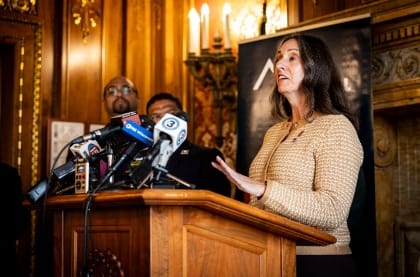
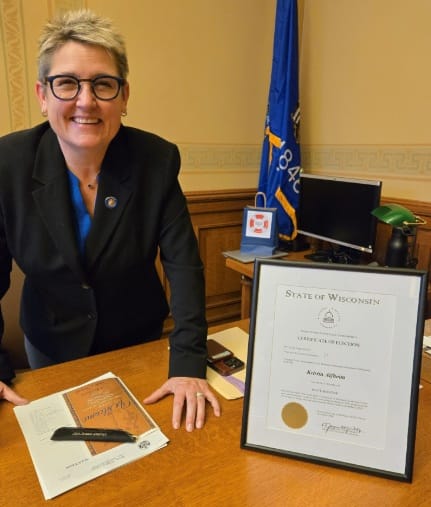
State Rep. Lee Snodgrass, left; and State Sen. Kristin Dassler-Alfheim
A large menu of things to address
The end of the hyper-gerrymandered Republican maps in 2023 that put dozens of seats in play – which, before, were Republican locks – combined with dissatisfaction with President Trump and the Republican Party that helped create a massive blue wave, swept Democrats to the state trifecta earlier this month. It has given them an opportunity to address critical issues they say have been neglected for nearly two decades. Everything from Medicaid expansion; to full funding for public schools; to childcare subsidies; and so much more, Some, such as plugging holes in agencies like the Department of Natural Resources or in programs like the Knowles-Nelson conservation fund are also critical, if less publicized.
“I mean, think about the budgetary holes in the DNR,” Snodgrass says. “We have not increased the price of fishing or hunting licenses since 2005. That is a significantly long amount of time that we have not done that in Wisconsin. Nobody obviously wants to raise that on a very popular outdoor recreation thing, but it's also not particularly realistic if we want to keep having people supply our ponds and rivers with fish, and to have wardens who are actually helping people enjoy those outdoor sports.”
Then there are Democratic plans to restore or shore up certain rights, including abortion access; labor laws, especially the repeal of Act 10 and a return to collective bargaining; greater voting access with fewer restrictions; and creating a friendlier environment for the LGBTQ+ community.
Snodgrass, echoing incoming Assembly Speaker Greta Neurbauer, says affordability would be at the top of everyone’s priority list.
“There are so many things that we're struggling to afford,” she says. “So everything that you see us doing from the budget bill to our first one hundred days is going to be focused on reducing costs for people. One of those things (Neubauer) talked about was healthy school meals for all.
That would save families who have children enrolled in school a fairly significant amount of money. So we want to start tackling those things right away.”
Whence the revenue to pay for Democrats' wish list?
While Democrats have several ideas for revenue enhancement they recognize there is a finite amount of money available, alongside a shrinking surplus and new looming state obligations when federal cuts to SNAP food benefits and Medicaid start impacting people next year. Snodgrass says the guiding principle is the most good for the most people.
“We'll be looking at healthcare,” she says. “I think a public option is very much on the table, so that people can buy into the state insurance system in a competitive market. Public education is one hundred percent in there because we just saw 34 failed referendums this past election. Then the bucket becomes what are we doing with housing? What are we doing with childcare, whether that's going to be some version of Child Care Counts, where sustaining funding is provided directly to those childcare providers, or whether or not it's some combination of tax credits for families.
“We have all talked about expanding the eligibility of the homestead tax credit for housing (which helps offset property tax and rental costs for low-income Wisconsinites), which would be really helpful.”
As for how it all gets paid for, Snodgrass mentions several currently untapped revenue sources. Closing loopholes on manufacturing and agriculture taxes will likely be on the table for discussion, she says. Closing the dark store loophole which allows big box stores to pay property taxes only on the valuation of the property itself and not on the value it derives from business operations, would generate significant revenue. The League of Wisconsin Municipalities estimates the loophole represents an eight percent shift of the tax burden onto homeowners and small businesses.
Then there is the option to legalize marijuana, which both the Wisconsin Legislative Fiscal Bureau and the Wisconsin Department of Revenue estimate could raise as much as $170 million annually, money being lost to surrounding states. Legalization is popular among nearly 80 percent of Wisconsinites.
“We know that it has statewide support,” Snodgrass says. “But it doesn’t happen all at once.
And we want to make sure that if we're going to legalize, we're legalizing in a way that doesn't disenfranchise small growers and shop owners. We want to make sure that this is an opportunity for revenue, not just for the state, but for small businesses. We don't want to turn the cannabis industry into another big business in Wisconsin. So we want to make sure that whatever we put into place is going to be protecting those smaller players in that field.”
Holding together the coalition
Snodgrass says she hopes some Democratic proposals bring along Republican support but, politics being what they are today, they may not want to allow Democrats to take credit for bipartisan legislation if they don’t have to. Still, it could be in their interest politically in two years and, more importantly, she says, in the interest of their constituents.
“Well, I think it'll be very hard for them if people see a meaningful difference in their lives to rail against (a bill) because if they rail against it, they're really putting down their own constituency,” she argues. “And they're going against the folks whose votes they need.”
Snodgrass says she’s not worried about fractiousness within the party getting in the way of obtaining the necessary votes to get legislation through.
“I think at the end of the day, if we pass legislation that doesn't raise costs and lowers expenses, it won't matter how somebody is voting,” she says. “I think that we want to be bold and do good things in this majority, and we also want it to be a sustaining majority. We don't want to squander it and have it be something that just flips in the next cycle, undoing all the good that we did.”
Process matters, too, insists Dassler-Alfheim, especially after the way the legislature has been run in recent years, with plenty of bills never receiving a hearing or expertise input.
“Democracy says you float a bill with co-sponsorship,” she says. “It gets sent to a public hearing where people on both sides get to have an opinion. It then goes to an executive committee where any adjustments are made. And then it comes to the floor.
“What we've not seen in the last handful of years are public hearings on topics that interest the bulk of Wisconsin. We certainly haven't had any executives where there's been an opportunity to discuss it, make it better. So, by getting us back to a democratic process, it's going to allow all of these conversations to be had fully in the public, hearing opinions on all sides, and then making good decisions.”
A Governor with legislative, executive experience a plus
Snodgrass says she is particularly optimistic about the new Governor. David Crowley, she insists, has been in the legislature, as well as a county executive, and knows how to work with people to get things done. Where there are conflicts, Snodgrass says, she’s confident he will be available for constructive conversations to get those conflicts resolved.
Dassler-Alfheim argues Democrats need to take a pragmatic, rather than idealistic, approach to governing.
“We always need to know what the positive and negative consequences (of a bill) would be,” she says. “With a great big magic marker, we have to make sure that we know the math on if we make it better for this many, are we actually making it worse for this many?”
Snodgrass admits her party is eager for the challenge and the responsibility of leading.
“I take this so seriously,” she says. “You know, there's obviously been celebrating and joy, which has been a long time coming. But it's not because it feels frivolous. It's because it feels so monumental, and I know we're at the precipice of something huge.
“It keeps me up at night. Like, I thought I would finally be able to sleep because I wouldn't have to worry about all the bad things happening. And now I can't sleep because of all the good possibilities.”


